
The landscape of domestic thermal management has shifted dramatically toward silent, efficient, and aesthetically integrated solutions. Among these, convection heating remains a cornerstone of residential comfort due to its ability to circulate air naturally without the noise of forced-air fans. However, the true intelligence of these systems lies hidden beneath the chassis: the convector heater control PCBA. This sophisticated electronic assembly is responsible for modulating power, ensuring safety, and providing the user interface that defines the modern heating experience. As energy costs rise and environmental standards tighten, the engineering of the electric heater PCBA has evolved from simple mechanical switching to complex digital regulation, enabling precise climate control that adapts to the specific needs of a modern household.
Residential convection heaters rely on the principle of buoyancy—cold air enters the bottom of the unit, is warmed by a heating element, and rises into the room. Maintaining this delicate balance of airflow and temperature requires a heater main control board that can respond in milliseconds to ambient changes. Unlike industrial heaters that prioritize raw power, residential units prioritize nuance, silence, and safety. A high-quality control board ensures that the heating element operates at the exact temperature required to maintain comfort without wasting electricity or causing the “burning dust” smell often associated with older, less sophisticated equipment.
The Core Architecture Of The Convector Heater Control PCBA
Designing a convector heater control PCBA for the residential market involves a unique set of engineering challenges. The board must be compact enough to fit into slim-line heater profiles while remaining robust enough to handle the thermal stress of continuous operation. Central to this design is the power management stage. Modern boards utilize high-quality triacs or solid-state relays rather than mechanical counterparts to eliminate the “clicking” sound that can disturb a quiet bedroom. This silent operation is a hallmark of premium convection systems, driven by the precision of the underlying electric heater PCBA.
The control logic on the heater main control board usually centers around a Proportional-Integral-Derivative (PID) algorithm. This mathematical model allows the heater to approach the target temperature gradually, preventing the overshoot and undershoot cycles that characterize cheaper heaters. By modulating the current flowing through the heating element, the PCBA can maintain a room’s temperature within a fraction of a degree. This not only improves comfort but also significantly reduces energy consumption, as the unit rarely needs to run at full power once the desired temperature is reached.
Safety Features Integrated Into The Electric Convection Heater Control Board
In a residential setting, safety is the primary concern for both manufacturers and homeowners. The electric convection heater control board acts as the ultimate fail-safe for the device. One of the most critical safety components is the tilt sensor, which is integrated directly into the electric heater PCBA. If the heater is knocked over by a pet or a child, the board instantly cuts power to the heating element to prevent a fire. This rapid response is essential for maintaining a safe living environment, particularly in high-traffic areas like living rooms or nurseries.
Furthermore, the convector heater control PCBA monitors for “thermal runaway” through multiple thermistor inputs. If the internal temperature of the heater exceeds a safe threshold—perhaps because a towel has been accidentally draped over the unit—the heater main control board will trigger an automatic shutdown. Modern boards also include “open window” detection logic; if the sensor detects a sudden, sharp drop in room temperature, the software assumes a window is open and pauses heating to prevent energy waste. These layers of intelligence transform a simple appliance into a proactive participant in home safety and efficiency.
Adapting Logic For The Garage Convection Heater Control Board
While residential rooms require silent nuance, transitional spaces like workshops or garages demand a different kind of resilience. A garage convection heater control board is engineered to survive in environments where dust, moisture, and extreme temperature fluctuations are common. The electric heater PCBA used in these settings often features conformal coating—a thin protective film that shields the delicate copper traces from corrosion and sawdust accumulation. Without this protection, the moist air of a garage could lead to short circuits or component failure within a single season.
The logic within a garage convection heater control board is also tuned for high-output performance. In a poorly insulated garage, the heater may need to run at maximum capacity for extended periods. Consequently, the power traces on the board are wider and thicker to prevent overheating during heavy use. Despite these ruggedized features, the board still maintains the same core safety protocols as its indoor counterparts, ensuring that even in a cluttered workshop, the heating process remains controlled and reliable.
User Interface And Connectivity In The Heater Main Control Board
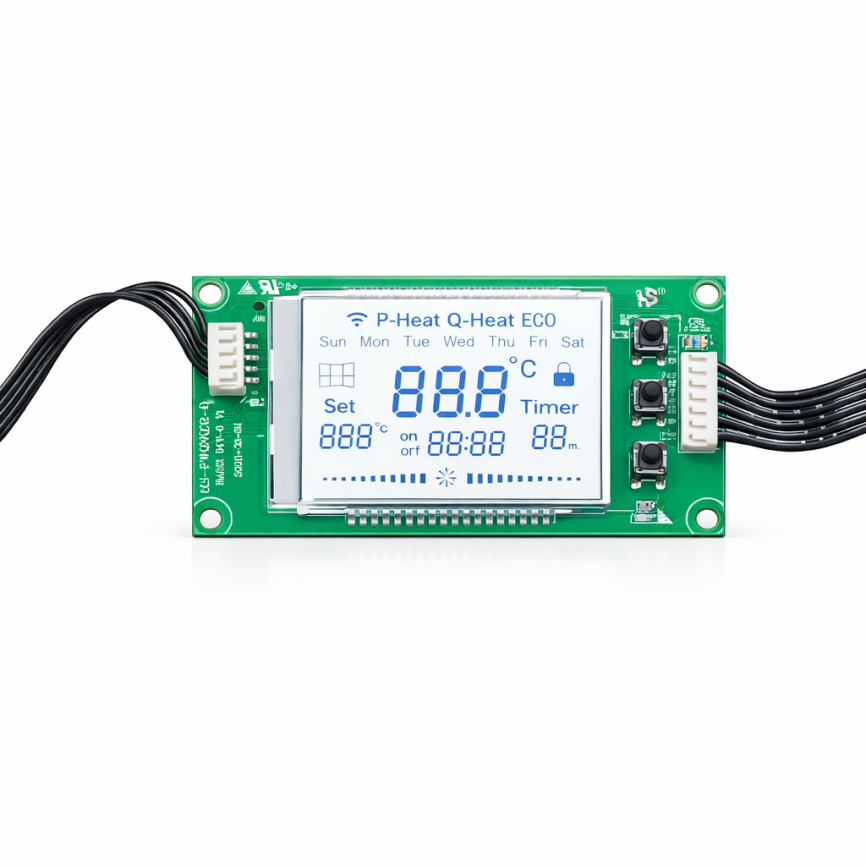
The modern consumer expects more than a simple dial to control their home’s temperature. The heater main control board of 2026 is often equipped with integrated Wi-Fi or Bluetooth modules, allowing for seamless integration into smart home ecosystems. Through a dedicated mobile app, users can set complex heating schedules, monitor their real-time energy usage, and even receive alerts if the convector heater control PCBA detects an operational anomaly. This connectivity turns a standalone heater into a part of a wider, energy-efficient network.
On the physical side, the electric convection heater control board must interface with touch-sensitive panels or high-definition LED displays. The PCBA manages the dimming of these displays at night and ensures that the touch inputs are responsive even through thick glass panels. This intersection of high-voltage power management and low-voltage user interface design is where the true engineering expertise of the electric heater PCBA is revealed. It requires a layout that isolates sensitive digital signals from the electromagnetic interference generated by the high-current heating circuit.