
The architecture of modern thermal management in heavy industry has undergone a radical transformation, moving away from simple analog relays toward sophisticated digital ecosystems. At the heart of this evolution is the engineering of the high-power electric heater control board, a component that must balance the raw energy of high-voltage currents with the delicate precision of microprocessor-based logic. In industrial environments where downtime equates to massive financial loss, the reliability of these control systems is paramount. Engineering these boards requires a deep understanding of thermodynamics, electromagnetic compatibility, and structural integrity, ensuring that the heating systems of 2026 can meet the rigorous demands of continuous operation without compromise.
Industrial heating applications, ranging from chemical processing to large-scale manufacturing kilns, necessitate a robust interface between the power grid and the heating elements. The industrial heater main control board serves as the central nervous system of this operation, coordinating complex sequences of power distribution, safety monitoring, and temperature regulation. Unlike residential heating controls, industrial variants must operate under extreme conditions, including high ambient temperatures, mechanical vibrations, and potential exposure to corrosive chemicals. Consequently, the design and manufacturing process carried out at a specialized industrial heater control board factory must adhere to military-grade standards to ensure longevity and safety.
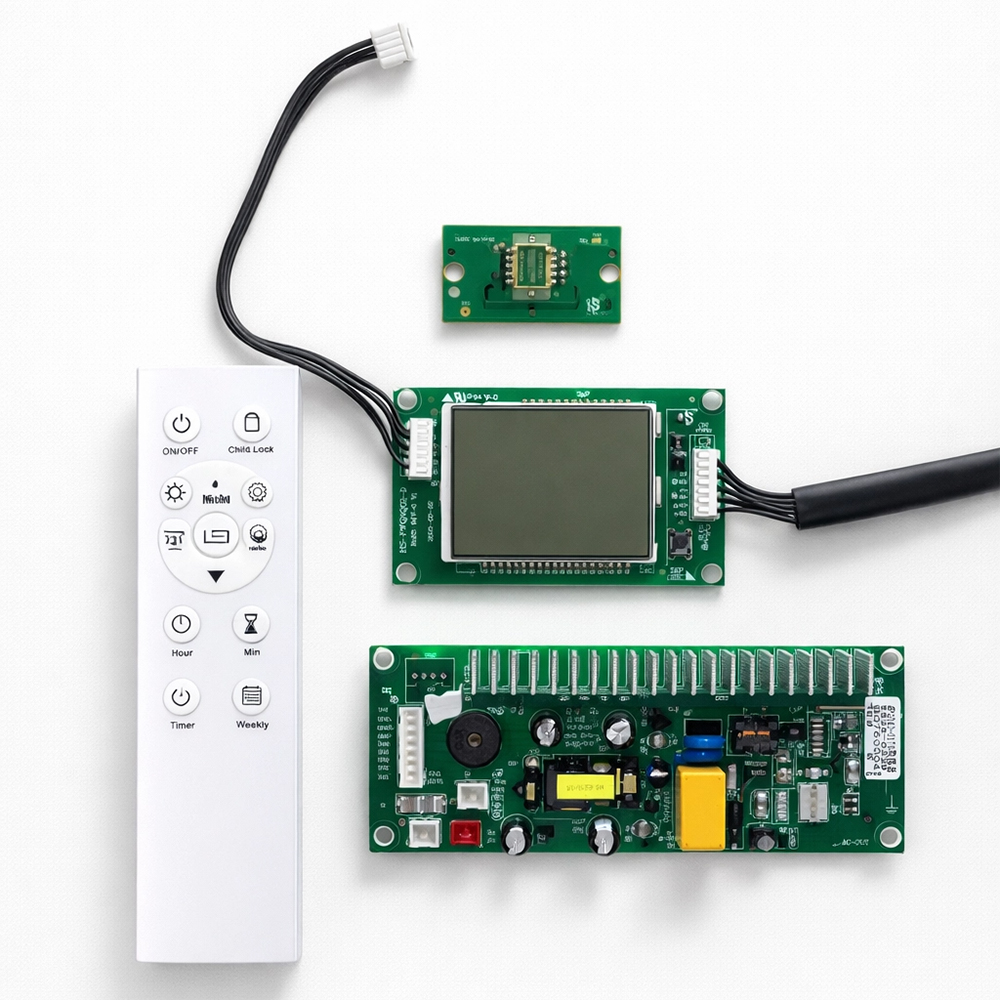
Technical Foundations of the High-Power Electric Heater Control Board
When designing a high-power electric heater control board, engineers must first address the primary challenge: heat dissipation within the control circuitry itself. Managing hundreds of kilowatts of energy creates significant thermal stress on the copper traces and switching components. To mitigate this, advanced PCB design techniques are utilized, such as heavy copper plating and the integration of ceramic or metal-core substrates. These materials allow the electric heater PCBA to conduct heat away from critical semiconductors, such as Insulated Gate Bipolar Transistors (IGBTs) or Silicon Controlled Rectifiers (SCRs), which are responsible for modulating the power flow to the industrial heating loads.
The logic behind the high-power electric heater control board often involves sophisticated pulse-width modulation (PWM) or zero-crossing switching strategies. These methods allow for precise temperature control while minimizing harmonic distortion on the electrical grid. In a large factory setting, where multiple high-power units may be operating simultaneously, reducing electrical noise is essential to prevent interference with other sensitive equipment. By optimizing the switching frequency and filtering on the industrial heater main control board, engineers can provide a clean, efficient power delivery system that maximizes the lifespan of the heating elements.
Reliability Engineering in the Industrial Heater Main Control Board
The structural integrity of the industrial heater main control board is defined by its ability to maintain operational consistency over years of service. In many industrial sectors, heaters are required to run 24/7 for months at a time. To support this, the board’s firmware and hardware must be designed with redundancy in mind. Modern boards now feature multi-layered protection circuits that can detect over-current, over-voltage, and sensor failures in real-time. This proactive monitoring is what differentiates a standard controller from a high-end heating element control board engineered for professional-grade applications.
Communication protocols also play a vital role in the modern industrial heater main control board. Most high-power systems are now integrated into broader industrial Internet of Things (IIoT) networks through Modbus, Profibus, or Ethernet/IP. This connectivity allows facility managers to monitor the health of the electric heater PCBA remotely, analyzing energy consumption patterns and predicting maintenance needs before a failure occurs. By embedding these communication modules directly into the control board, manufacturers can offer a “smart” solution that enhances the overall efficiency of the industrial plant.
The Precision Manufacturing Process at an Industrial Heater Control Board Factory
Producing a high-performance electric heater PCBA is a task that requires specialized equipment and rigorous quality control measures. An industrial heater control board factory must utilize automated optical inspection (AOI) and X-ray testing to ensure that every solder joint can withstand the thermal cycling inherent in industrial heating. Because the components on a high-power electric heater control board are often larger and heavier than those on consumer electronics, the surface mount technology (SMT) process must be calibrated to handle unique mechanical stresses.
Furthermore, the environment of the industrial heater control board factory itself must be strictly controlled to prevent contamination. Even a microscopic particle of dust or moisture trapped under a conformal coating can lead to a catastrophic short circuit when the board is subjected to high voltages in the field. To prevent this, professional-grade boards undergo a series of stress tests, including burn-in testing at elevated temperatures and vibration testing. This ensures that the heating element control board arriving at a client’s site is ready to perform under the most punishing conditions without the risk of early-life failure.
Optimizing the Heating Element Control Board for Versatile Applications
A versatile heating element control board must be adaptable to various types of heating technologies, including resistive, inductive, and infrared. Each of these methods requires a different control curve and safety threshold. For instance, inductive heating involves high-frequency magnetic fields that require the electric heater PCBA to have superior electromagnetic shielding. On the other hand, resistive heating focuses on current stability and thermal lag management. By developing a modular architecture, an industrial heater control board factory can provide customized solutions that meet the specific needs of different industrial sectors while maintaining a core platform of reliability.
The software layer of the heating element control board is where much of the modern innovation occurs. Advanced PID (Proportional-Integral-Derivative) algorithms are now being replaced or augmented by artificial intelligence and machine learning models. These “self-tuning” controllers can learn the thermal characteristics of a specific industrial oven or reactor, adjusting the power output of the high-power electric heater control board to reach the target temperature faster and with less overshoot. This not only improves product quality in manufacturing but also significantly reduces energy waste, aligning the heating system with modern sustainability goals.