
The industrial landscape demands a level of thermal precision and mechanical endurance that far exceeds the requirements of consumer-grade appliances. In sectors ranging from chemical processing to large-scale plastic injection molding, the stability of the thermal environment is directly tied to the quality of the output and the safety of the facility. At the core of these high-stakes operations is the industrial electric heater PCBA, a high-density electronic assembly designed to regulate massive electrical loads while maintaining micro-second response times to temperature fluctuations. Maximizing the performance of these systems requires a deep understanding of power electronics, thermal management, and signal integrity, as even a minor failure in the control circuitry can lead to significant downtime or catastrophic equipment damage.
Performance optimization begins with the physical architecture of the circuit board itself. An industrial electric heater PCBA must be designed to withstand “thermal cycling,” a phenomenon where the repeated heating and cooling of the board causes mechanical stress on the solder joints and copper traces. Engineers address this by utilizing heavy copper weights and high-Tg (glass transition temperature) substrates that maintain their structural integrity at elevated temperatures. By ensuring that the foundational material of the board can handle the rigors of an industrial environment, manufacturers provide a stable platform for the sophisticated logic and power switching components that define modern thermal control.
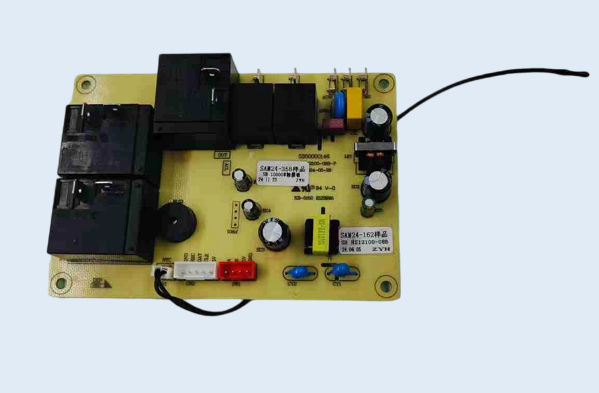
Technical Resilience Of The Industrial Heater Main Control Board
The industrial heater main control board acts as the central intelligence of the entire heating system, coordinating inputs from multiple high-precision sensors and translating them into actionable power commands. To maximize performance, these boards often employ advanced 32-bit microcontrollers capable of running complex PID (Proportional-Integral-Derivative) algorithms. These algorithms ensure that the heater reaches its target temperature rapidly without “overshooting,” which is critical in processes involving heat-sensitive materials. The industrial heater main control board must also manage a wide array of communication protocols, such as Modbus or Profibus, allowing it to integrate seamlessly into a factory-wide SCADA (Supervisory Control and Data Acquisition) system.
Beyond logic, the resilience of the industrial heater main control board is measured by its ability to filter out electromagnetic interference (EMI). Industrial floors are noisy environments, filled with large motors and high-frequency switching power supplies that can corrupt the sensitive low-voltage signals used for temperature monitoring. High-performance main boards utilize localized shielding, differential signaling, and optoisolation to protect the data paths. This ensures that the temperature readings remain accurate to within a fraction of a degree, providing the stable feedback loop necessary for high-precision industrial manufacturing.
Engineering Challenges Of The 5t High-Power Heater Control Board
When dealing with massive scale, such as in the case of a 5t high-power heater control board, the engineering requirements shift toward extreme current management and heat dissipation. A “5-ton” equivalent heating system involves tens of kilowatts of energy, which generates significant heat within the control board itself. To maximize performance in these high-wattage applications, designers must utilize specialized “busbar” technology integrated directly into the PCB. These thick copper bars carry the bulk of the current, reducing the resistive heating that would otherwise delaminate a standard circuit board.
The 5t high-power heater control board also requires specialized gate drivers for the IGBTs (Insulated-Gate Bipolar Transistors) or MOSFETs that switch the load. These drivers must provide isolated, high-speed switching to minimize “switching losses,” which represent energy wasted as heat during the transition between on and off states. By optimizing the switching frequency and the rise/fall times of the power pulses, engineers can significantly improve the overall efficiency of the system. This not only reduces the operational cost for the end-user but also minimizes the thermal stress on the internal components of the control unit, leading to a much longer service life.
Safety Redundancy In High-Power Electric Heater Control Board Design
In any high-energy application, safety is the ultimate performance metric. A high-power electric heater control board is designed with multiple redundant layers of protection to prevent runaway thermal events. Hardware-level “watchdog” timers are standard, ensuring that if the main processor hangs or crashes, the power to the heating elements is immediately cut. Furthermore, a professional high-power electric heater control board includes phase-loss detection and over-current protection that operates independently of the software. This ensures that even in the event of a catastrophic code failure, the physical hardware will protect itself and the facility.
Thermal monitoring on a high-power electric heater control board is not limited to the external heating element; it also extends to the board’s own power components. Integrated thermal sensors monitor the temperature of the heat sinks and the power traces. If the internal temperature of the control unit exceeds a certain threshold—perhaps due to a cooling fan failure—the board will automatically “derate” its output, lowering the power to a safe level until the temperature stabilizes. This intelligent self-preservation capability is what separates industrial-grade electronics from generic power controllers, providing the reliability required for 24/7 industrial operation.
Selecting The Right Industrial Heater Control Board Factory
The final step in maximizing performance is choosing the right production partner. An industrial heater control board factory must possess specialized equipment that goes beyond standard consumer electronics assembly. For example, high-power boards often require “selective soldering” or “vapor phase reflow” to handle the large thermal mass of the heavy copper traces and massive power components. A dedicated industrial heater control board factory will also have extensive testing facilities, including burn-in chambers where boards are operated at full load under elevated temperatures for several days to identify “infant mortality” failures before shipping.
Quality control at an industrial heater control board factory also involves meticulous component sourcing. In the industrial sector, the use of “counterfeit” or sub-standard capacitors and transistors is a major risk, as these components may fail under the stress of high-power operation. A reputable factory maintains a strictly audited supply chain and utilizes Automated Optical Inspection (AOI) and X-ray inspection to ensure that every solder joint is perfect. By partnering with a factory that understands the unique demands of the industrial sector, brands can ensure that their heating systems deliver peak performance from the first day of installation through years of heavy-duty use.