
The architectural landscape of the twenty-first century is undergoing a profound digital metamorphosis, moving away from static structures toward sentient, responsive environments. Central to this evolution is the concept of climate autonomy, where thermal comfort is no longer managed by manual thermostats but by a complex, interconnected heating system control PCBA solution. In large-scale smart buildings, the challenge lies in balancing the immediate comfort of occupants with the rigorous demands of energy efficiency and sustainability. An integrated control solution serves as the neurological hub of this operation, synthesizing data from hundreds of environmental sensors to deliver precise, localized warmth. This sophisticated electronic architecture is the bridge between traditional HVAC mechanics and the future of autonomous building management.
Implementing a comprehensive heating system control PCBA solution requires a deep understanding of multi-zone thermal dynamics. Unlike residential units, commercial smart buildings feature diverse thermal loads—ranging from sun-drenched glass atria to windowless interior server rooms. The PCBA must be capable of processing high-speed data inputs while managing a distributed network of actuators, pumps, and heating elements. By utilizing high-performance microcontrollers and robust communication protocols like BACnet or Zigbee, these integrated solutions ensure that heat is only generated where and when it is needed, drastically reducing the carbon footprint of the structure while enhancing the longevity of the mechanical hardware.
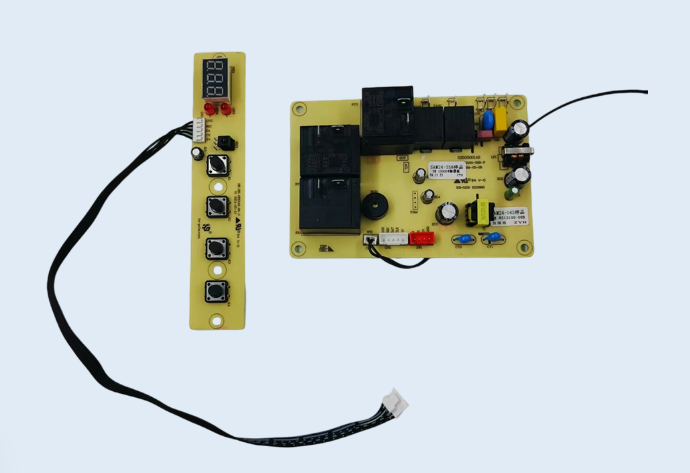
Technical Innovation In Smart Heater PCBA Architecture
The intelligence of a modern building is localized within the smart heater PCBA installed in individual terminal units. These boards are much more than simple power switches; they are edge-computing devices capable of learning occupant behavior and predicting thermal needs. A high-quality smart heater PCBA utilizes artificial intelligence to analyze patterns—identifying, for instance, that a specific conference room requires pre-heating at nine o’clock every Monday morning. This predictive capability eliminates the energy spikes associated with rapid heating, instead favoring a gradual, efficient ramp-up that preserves the integrity of the heating elements.
From an engineering perspective, the smart heater PCBA must also manage the complexity of wireless coexistence. In a building filled with Wi-Fi routers, cellular signals, and other smart devices, the heater’s control board must maintain a stable connection to the central management system without interference. Designers achieve this through advanced RF shielding and the use of frequency-hopping spread spectrum (FHSS) technology. Furthermore, these boards often include integrated power quality monitoring, detecting voltage sags or surges that could damage the heater. By reporting these anomalies in real-time, the smart PCBA acts as a diagnostic tool, allowing facilities managers to address electrical issues before they lead to a system-wide failure.
Safety And Precision Of The Electric Heater Control Board
When dealing with high-wattage thermal applications, safety is the primary metric of performance. The electric heater control board is the first line of defense against thermal runaway and electrical hazards. Modern boards are engineered with redundant hardware-level interrupts that operate independently of the software. For example, if a temperature sensor fails and reports an erroneously low reading, a physical thermal fuse integrated into the electric heater control board will still trigger a hard shutdown if the chassis reaches a critical temperature. This “defense-in-depth” strategy is essential for meeting international safety standards and providing peace of mind to building owners.
Precision is equally vital, particularly in buildings that utilize radiant or hydronic heating. The electric heater control board utilizes Pulse Width Modulation (PWM) or Silicon Controlled Rectifier (SCR) power tuning to adjust the heat output with surgical accuracy. Instead of a jarring “on-off” cycle, the board provides a continuous, modulated flow of energy. This not only results in a more stable room temperature but also minimizes the mechanical noise and thermal stress on the heating coils. By eliminating the constant expansion and contraction associated with binary switching, the control board significantly extends the mean time between failures (MTBF) for the entire heating assembly.
Centralized Governance Via The Heater Main Control Board
In a smart building’s mechanical room, the heater main control board acts as the supreme coordinator for the primary heat source—whether it be a massive boiler bank or a high-capacity heat pump array. This board is responsible for “load leveling,” which involves distributing the thermal demand across multiple units to ensure that no single heater is overstressed. The heater main control board monitors the health of each sub-system, tracking run-time hours and energy consumption. When it detects that one unit is nearing its maintenance interval, it can automatically shift the load to a standby unit and alert the maintenance crew.
The communication capabilities of the heater main control board are what truly enable the “smart” in smart buildings. These boards often feature dual-ethernet ports and localized web servers, allowing engineers to log in remotely to tweak performance parameters or update firmware. In the event of an emergency, such as a fire alarm activation, the main control board can immediately interface with the building’s safety system to shut down all heating and air circulation, preventing the spread of smoke. This level of system-wide integration ensures that the heating infrastructure is not a siloed utility but an active participant in the building’s overall safety and operational logic.
Strategic Partnerships In Heater Control Board OEM ODM
For developers and brands looking to lead the smart building market, the path to innovation often lies in choosing a partner with extensive heater control board oem odm experience. The journey from a conceptual thermal requirement to a mass-produced, certified PCBA is fraught with regulatory and technical hurdles. An Original Design Manufacturer (ODM) provides a library of pre-certified circuit modules and firmware blocks, allowing a brand to bring a new product to market in a fraction of the time. Conversely, Original Equipment Manufacturing (OEM) services allow for the realization of highly specialized, proprietary designs that cater to niche architectural requirements.
A partner specializing in heater control board oem odm brings a wealth of manufacturing knowledge, such as Design for Excellence (DFX) and Automated Optical Inspection (AOI) protocols. They understand the nuances of high-power PCB layouts—ensuring that heavy copper traces are utilized for high-current paths while maintaining high isolation for sensitive logic signals. This manufacturing expertise is critical for ensuring that the final product can withstand the high-vibration and high-temperature environments typical of industrial HVAC rooms. By collaborating with a dedicated PCBA manufacturer, brands can focus on their core competencies while being assured that the electronic heart of their heating system is built to the highest global standards.