
The garage is one of the most demanding environments for any electronic appliance. Unlike the climate-controlled interior of a home, a garage is subject to extreme temperature swings, high humidity, dust accumulation, and even chemical vapors from vehicles or DIY projects. For those who rely on localized heating to maintain a workable workspace during winter, the garage convection heater control board is the silent engine that must withstand these grueling conditions. Durability in this context is not just an advantage; it is a fundamental requirement. The engineering behind these boards focuses on protecting sensitive silicon and copper components from the oxidative and thermal stresses that characterize uninsulated utility spaces. When a control board fails in a garage heater, it is rarely due to a software glitch; it is almost always a result of environmental wear and tear on the physical hardware.
To ensure long-term survival, a high-quality garage convection heater control board utilizes heavy-duty substrates and reinforced solder joints. Standard consumer electronics often use thin circuit traces that can crack under the mechanical stress of thermal expansion. In a garage, where a heater might go from freezing temperatures to high heat in a matter of minutes, this expansion is violent. Modern boards are built with high-thermal-stability resins that prevent the board from warping or delaminating. This foundational resilience ensures that the board remains a stable platform for the complex logic required to safely manage the convection heating process.
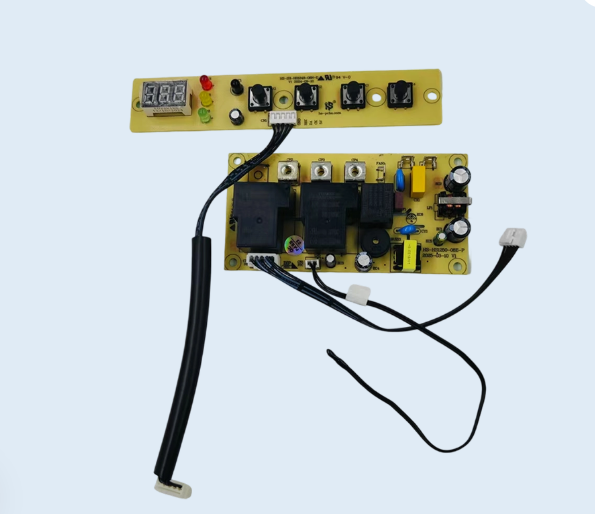
Environmental Protection For The Electric Convection Heater Control Board
The primary enemy of any electric convection heater control board located in a garage is moisture. Condensation is a frequent occurrence when warm air from the heater meets the cold surfaces of the garage walls or the heater chassis itself. To combat this, professional-grade boards are treated with a conformal coating—a transparent polymer film that wraps around every resistor, capacitor, and integrated circuit. This barrier prevents water droplets from bridging electrical paths, which would otherwise cause a short circuit or lead to the slow, destructive growth of copper dendrites. Without this specialized coating, an electric convection heater control board would likely fail within a few seasons due to the inevitable humidity of an unsealed environment.
Dust and airborne debris also pose a significant threat. In a garage where woodworking or sanding might take place, fine particulates can settle on the electronics. If these particles are metallic or moisture-absorbent, they can create unintended conductive paths. The design of a modern electric convection heater control board often includes physical shielding or enclosures that allow for airflow—necessary for cooling—while preventing large particles from settling on the sensitive logic sections. By engineering the board to be “dust-resilient,” manufacturers ensure that the heater remains a reliable tool for the hobbyist or mechanic, regardless of the messiness of the work being performed.
Thermal Stress Management In The Garage Heater Control Board
Managing high-current loads is the most taxing responsibility of the garage heater control board. Convection heaters work by drawing air over a heating element, a process that requires a significant amount of electrical energy. This energy generates heat not just at the element, but within the control board’s own power-switching components, such as relays or triacs. A durable garage heater control board is equipped with oversized heat sinks and thick copper pours that act as thermal sponges, drawing excess heat away from the sensitive microcontroller and dispersing it into the air. If the board cannot manage its own heat, it will suffer from “thermal fatigue,” eventually leading to the failure of the electrolytic capacitors or the melting of the plastic connectors.
The switching mechanism itself is a masterpiece of durability. While traditional mechanical relays are prone to arcing—a tiny spark that occurs every time the heater turns on or off—modern garage heater control board designs often incorporate solid-state switching or “zero-crossing” technology. This ensures that the electrical connection is made at the exact moment the AC voltage is at zero, eliminating the spark and significantly extending the life of the switch. For a heater that might cycle on and off hundreds of times during a cold weekend, this reduction in electrical wear is the difference between a board that lasts three years and one that lasts a decade.
Component Reliability In A Space Heater Control Board For Garage Use
In the specialized niche of a space heater control board for garage applications, component selection is far more rigorous than in standard home appliances. Engineers specify “industrial-grade” components that are rated for a wider temperature range—typically from -40°C to +85°C. This ensures that even if the garage is freezing cold when the user enters, the space heater control board for garage will initialize and operate without the components becoming brittle or losing their electrical characteristics. Capacitors, in particular, are a focal point; low-quality capacitors can leak or bulge when exposed to extreme cold, but the high-end versions found in garage-specific boards use stable electrolytes designed for the long haul.
Safety redundancy is another pillar of durability. A space heater control board for garage use includes multiple temperature sensors—not just for the room, but for the board itself and the heating element. If the airflow is blocked by a misplaced box or a pile of rags, the sensors detect the rapid rise in temperature and the board initiates a hard shutdown. This prevents the board from being exposed to temperatures that would permanently damage its internal circuitry. By protecting itself from user error and environmental accidents, the control board ensures that the heater remains a safe and functional part of the garage ecosystem for many years.
The Central Governance Of The Heater Main Control Board
At the heart of the system is the heater main control board, which coordinates the various sub-components into a harmonious heating cycle. This board must be intelligent enough to ignore minor power fluctuations or “noise” on the electrical line, which is common in garages where large power tools might be starting and stopping. A durable heater main control board features robust power filtration circuitry that “cleans” the incoming electricity before it reaches the sensitive logic gates. This protects the board from the voltage spikes that can occur when a table saw or a compressor kicks in on the same circuit.
Furthermore, the heater main control board is designed for easy diagnostics. Many modern units include LED error codes or even wireless diagnostic capabilities that allow the user to see exactly why a heater might not be starting. This serviceability is a key aspect of durability; if a minor sensor fails, a well-designed heater main control board allows for that specific part to be identified and replaced, rather than requiring the disposal of the entire heater. This “modular” approach to durability reflects a commitment to quality and longevity, ensuring that the heart of the heater continues to beat even in the harshest winter conditions.