
The science of humidity management has undergone a profound transformation, shifting from rudimentary mechanical evaporation to sophisticated thermodynamic regulation. At the center of this evolution is the evaporative heating control PCBA, a specialized electronic assembly that orchestrates the delicate interplay between moisture saturation and thermal energy. In modern residential and industrial environments, the demand for “warm mist” or “hygienic evaporation” has led to the development of systems that don’t just move water into the air, but carefully condition it through controlled heating. This process requires an intelligent interface capable of managing high-current thermal loads while maintaining the sensitive logic required for humidity sensing and user safety.
Precision in an evaporative heating control PCBA is not merely a luxury; it is a requirement for both efficiency and hygiene. When water is heated to the point of evaporation, the energy consumption must be optimized to prevent waste, while the temperature must be high enough to neutralize waterborne pathogens. Modern circuit designs achieve this through advanced power-switching components and high-speed microcontrollers. These boards act as the brain of the appliance, ensuring that the transition from liquid to vapor occurs in a steady, controlled manner that enhances the indoor climate without creating excessive condensation or energy spikes.
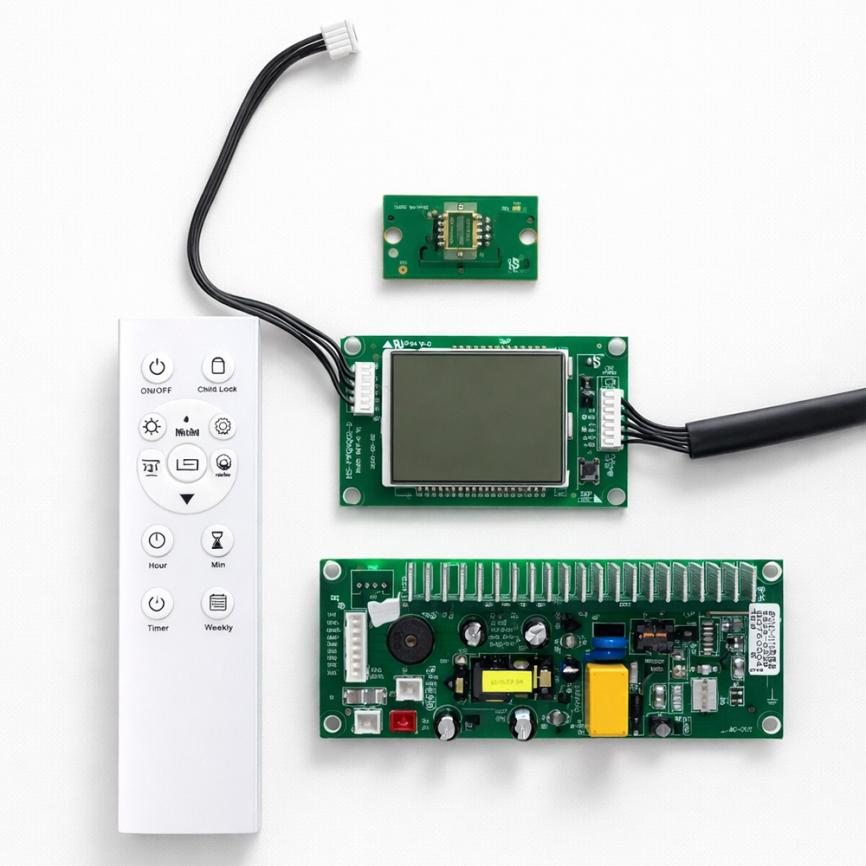
Technical Architecture Of The Evaporative Humidifier Heater Control Board
Designing a robust evaporative humidifier heater control board involves overcoming significant environmental challenges. Because these boards are located in close proximity to high-humidity zones and heat sources, they are subject to constant thermal expansion and potential moisture ingress. Engineers address this by utilizing high-temperature FR-4 substrates and specialized conformal coatings that protect the copper traces from oxidation. The architecture of a professional evaporative humidifier heater control board typically separates the low-voltage control logic from the high-voltage AC power section, using optoisolators or magnetic isolation to prevent electrical noise from interfering with the sensitive humidity sensors.
Furthermore, the integration of Proportional-Integral-Derivative (PID) control logic within the evaporative humidifier heater control board allow for much smoother temperature transitions. Instead of a simple “on-off” thermostat approach, which can lead to fluctuating humidity levels and mechanical stress on the heater, PID algorithms allow the board to modulate power delivery. This results in a “whisper-quiet” operation and a consistent output of warm vapor that feels natural to the occupants. This level of control is what defines the premium tier of modern humidification systems, providing a stable environment for everything from delicate musical instruments to sensitive respiratory systems.
Safety Systems Integrated Into Warm Mist Humidifier Heater PCBA
In any appliance that combines water and electricity, safety is the paramount engineering concern. The warm mist humidifier heater PCBA is equipped with multiple layers of hardware and software fail-safes. The most critical of these is the “dry-boil” protection. Utilizing either capacitive sensors or NTC thermistors, the warm mist humidifier heater PCBA constantly monitors the presence of water in the heating chamber. If the water level drops below a safe threshold, the board must be capable of cutting power to the heating element in milliseconds. This prevents the plastic housing from melting and eliminates the risk of fire, a common failure point in older, less sophisticated humidification devices.
Another innovation in warm mist humidifier heater PCBA design is the inclusion of tilt and tip-over sensors. Since warm mist units contain hot water, an accidental knock-over could be dangerous. The PCBA processes signals from integrated accelerometers or mechanical tilt switches to immediately shut down the heating element and the fan motor. Additionally, modern boards often feature “soft-start” technology, which gradually increases the current to the heater rather than hitting it with a full load instantly. This reduces the electrical stress on the household circuit and prevents the “flicker” effect sometimes seen in lights when a high-wattage appliance kicks in.
Optimizing Efficiency Through The Heating Element Control Board
The core functionality of any thermal system resides in the heating element control board. Its primary task is to manage the power output of the resistive heating coil or ceramic PTC (Positive Temperature Coefficient) heater. Ceramic heaters are increasingly popular because they are inherently self-regulating, but they still require a sophisticated heating element control board to manage the start-up current and to interface with the user’s desired settings. The board uses Pulse Width Modulation (PWM) to adjust the energy delivered to the element, allowing the device to maintain a precise temperature with minimal energy waste.
Efficient heat transfer is also managed through the heating element control board’s coordination with the fan or blower system. If the fan speed is too high, the air will cool the heating element too quickly, leading to inefficient evaporation. If it is too low, the unit may overheat. The control board balances these two variables in real-time, creating an optimal thermodynamic “envelope” for evaporation. This synergy not only increases the longevity of the heating element itself but also ensures that the moisture output is warm and soothing rather than scalding or barely tepid.
Customization Potential Of The Electric Heater PCBA
As the smart home market grows, the electric heater PCBA must evolve to include connectivity and personalization features. Modern manufacturers are now designing these boards with integrated Wi-Fi or Bluetooth modules, allowing users to control their humidity levels via a smartphone app. An advanced electric heater PCBA can be programmed with specific “sleep modes” that reduce the noise and light output at night, or “health modes” that maximize the sterilization temperature of the water. This level of customization transforms the humidifier from a simple appliance into a comprehensive wellness tool.
Choosing a high-quality electric heater PCBA provider is essential for brands that want to maintain a reputation for quality. A well-engineered board will feature high-grade capacitors and robust relays that can withstand hundreds of thousands of cycles. For industrial applications, these boards may also include data logging capabilities, tracking the performance and energy consumption of the heating system over time. Whether it is for a small bedside unit or a large-scale commercial evaporative system, the PCBA is the fundamental pillar that ensures the electric heater operates with precision, safety, and durability.