
The modern home is undergoing a rapid transformation where traditional comfort products are being reimagined through the lens of sophisticated electronics and user-centric design. Among these innovations, the water-circulating heating blanket has emerged as a premium alternative to classic electric blankets, offering a safer, more consistent, and more natural warmth. However, the true intelligence of these systems lies not in the fabric or the silicone tubing, but in the sophisticated smart temperature control water heating blanket pcba that manages the delicate balance between thermal efficiency and user safety. As consumers demand more intuitive ways to interact with their appliances, the integration of advanced input methods and auditory confirmation systems has become the new standard for high-end home climate control.
A high-performance water heating blanket control board serves as the central nervous system of the entire appliance. It must simultaneously monitor water levels, regulate the heating element, manage the silent pump’s duty cycle, and provide a seamless interface for the user. In the past, these systems relied on simple membrane switches and static LED displays, which often felt clunky and imprecise. The shift toward more tactical and interactive components—specifically the rotary encoder and voice synthesis modules—represents a significant leap forward in the ergonomics of domestic comfort technology.
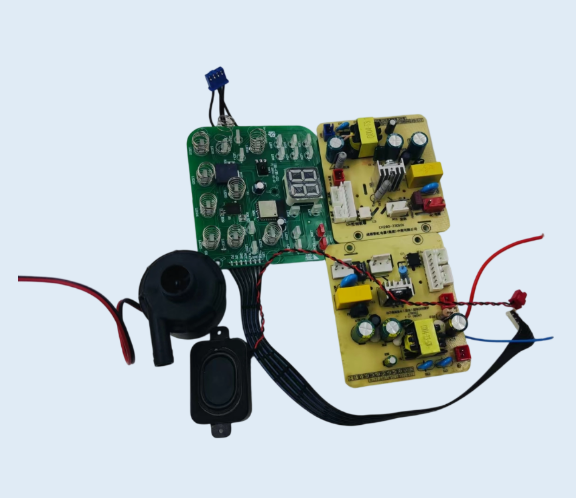
The Precision Of The Rotary Encoder Water Heating Blanket Control Board
One of the most significant upgrades in contemporary controller design is the transition to a rotary encoder water heating blanket control board. Unlike traditional buttons that require multiple presses to reach a desired temperature, a rotary encoder allows for a fluid, analog-like interaction. The user can quickly dial in a specific degree of warmth with satisfying haptic clicks, providing a sense of precision that buttons simply cannot match. This component is particularly beneficial for a temperature-controlled heated blanket pcba because it allows for granular adjustments. Whether a user wants to increase the heat by a single degree or quickly jump from a standby mode to a pre-heat setting, the rotary encoder provides a high-speed, high-accuracy input method that feels premium and durable.
From a technical standpoint, the integration of a rotary encoder onto the water heating blanket control board reduces the mechanical failure points often associated with membrane or tactile switches. Because an encoder typically utilizes optical or magnetic sensing to track rotation, it is less prone to the wear and tear of physical contact. This longevity is critical for appliances that are used daily throughout the winter months. Furthermore, the encoder often doubles as a push-button, allowing the PCBA to implement “push-to-confirm” logic or “long-press for timer” functions, effectively consolidating multiple control features into a single, elegant component.
Enhancing Accessibility With A Voice Feedback Water Circulation Heater Control Board
As smart home technology becomes more inclusive, accessibility features are moving from the periphery to the core of product development. The inclusion of a voice feedback water circulation heater control board is a game-changer for users with visual impairments or for those who simply prefer not to fumble for a remote in a dark bedroom. When a user turns the rotary knob or adjusts a setting, a clear, synthesized voice provides immediate confirmation of the action. This auditory bridge ensures that the user always knows the exact status of their blanket—whether it is confirming “Temperature set to thirty-eight degrees” or providing a safety alert such as “Please add water.”
The PCBA solution for a voice feedback water circulation heater control board involves the integration of a specialized voice synthesis chip or a high-capacity MCU capable of storing compressed audio files. This is not merely a novelty; it is a critical safety feature. If the system detects a tilt, a blockage in the circulation hose, or an overheating event, the voice feedback system can provide a descriptive warning rather than an ambiguous beep. This allows the user to troubleshoot the issue immediately without needing to consult a manual or decipher an error code on a small screen. By humanizing the interaction, the smart temperature control water heating blanket pcba creates a more trusting relationship between the user and the appliance.
Advanced Thermal Management In A Temperature-Controlled Heated Blanket PCBA
At the heart of the temperature-controlled heated blanket pcba is a sophisticated Proportional-Integral-Derivative (PID) algorithm. Managing water temperature is significantly different from managing a dry heating wire. Water has a higher thermal mass, meaning it takes longer to heat up and longer to cool down. A standard “on/off” thermostat would result in noticeable temperature swings that detract from the user experience. Instead, the smart temperature control water heating blanket pcba utilizes pulse-width modulation (PWM) to finely tune the power delivered to the heating element.
By constantly analyzing data from high-precision NTC thermistors placed at both the water inlet and outlet, the water heating blanket control board can predict thermal trends. It slows down the heating process as the water approaches the target temperature, preventing “overshoot” and ensuring a perfectly steady warmth throughout the night. This level of control is essential for preventing the dry skin and dehydration often associated with older electric blanket technologies. The result is a “constant temperature” environment that mimics the natural heat of the human body, promoting deeper and more restful sleep cycles.
Safety Protocols Within The Smart Temperature Control Water Heating Blanket PCBA
Safety is the paramount concern for any device that combines water and electricity. A professional smart temperature control water heating blanket pcba incorporates multiple layers of redundant protection. These include hardware-level over-current protection, software-level temperature limits, and mechanical tilt switches that instantly cut power if the heater unit is knocked over. Furthermore, the board must manage the water pump with extreme care. If the pump runs dry, it can burn out in seconds; therefore, the PCBA includes water level sensors that prevent the heating cycle from starting unless the system is properly primed.
The integration of the rotary encoder water heating blanket control board also plays into this safety ecosystem. Designers can program the encoder to require a “push and turn” action to unlock high-temperature modes, acting as a digital child lock. Additionally, the voice feedback water circulation heater control board can announce a “Self-check complete” sequence upon startup, giving the user peace of mind that all sensors and safety valves are functioning correctly. This comprehensive approach to safety ensures that the product meets stringent international standards, such as CE, UL, or RoHS, which is vital for foreign trade merchants looking to export these systems to global markets.