APPLICATIONS & SOLUTIONS / EMBEDDED CONTROL
Embedded Control Solutions with STM32 Product Intelligence
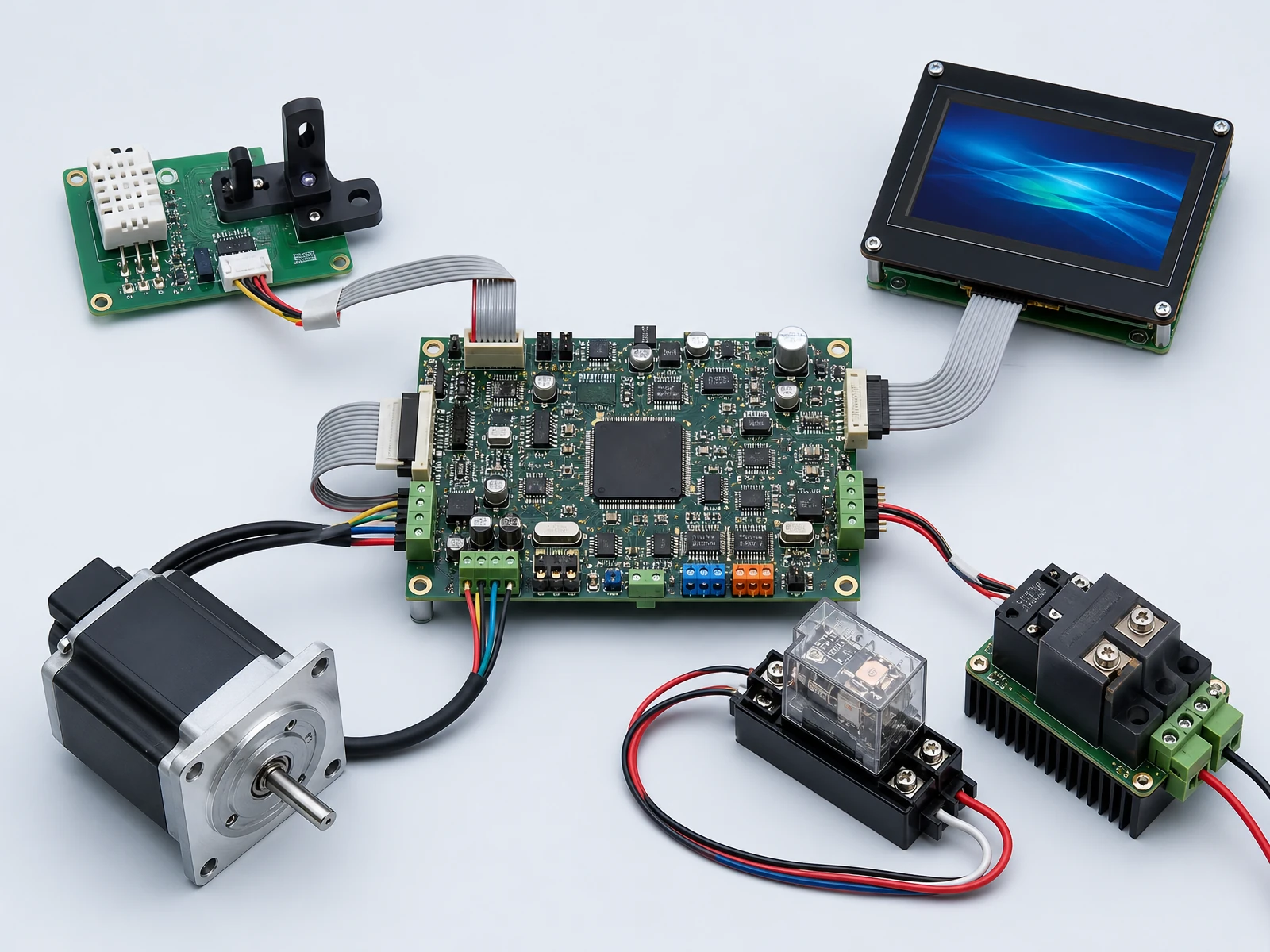
Bring STM32 processing, sensing, actuator control, user interfaces and communication together in one practical embedded architecture built around how the product must behave.
- STM32 / MCU Logic
- Sensor Inputs
- Actuator Outputs
- HMI & Communication
CONTROL SYSTEM QUESTIONS
Define behavior before selecting the board
A useful embedded controller begins with the product states, inputs, outputs and failure behavior. Processor choice follows those requirements.
What must be sensed?
Define signal type, accuracy, update rate, conditioning and the operating environment.
What must be controlled?
Map motors, relays, heaters, valves, lighting and other loads to their operating states.
How does the user interact?
Coordinate buttons, knobs, touch, displays, indicators and audible feedback.
What happens during a fault?
Specify limits, fallback states, error reporting, reset behavior and service access.
EMBEDDED CONTROL ARCHITECTURE
Inputs and outputs coordinated by one control core
The architecture translates physical signals and user commands into deterministic product actions, while communication and diagnostics expose the information other systems need.
Sensors
Temperature, pressure, motion, current, voltage, position and product-specific signals.
Buttons & HMI
Keys, knobs, touch interfaces, switches and commands from an external controller.
STM32 / MCU + Embedded Logic
State management, timing, signal processing, control algorithms, diagnostics and fault response.
Actuators & Power
Motors, relays, valves, heaters, fans, lighting and other product loads.
Display & Communication
Indicators, displays, UART, I2C, SPI, CAN, RS485 or wireless modules as required.
CORE SOLUTION LAYERS
Hardware and firmware shaped around the same state model
The board and firmware are coordinated around the product sequence rather than developed as disconnected parts.
Requirements & State Logic
Operating modes, transitions, timing, priorities and abnormal states translated into an implementable control model.
MCU & Resource Planning
Processing, memory, peripherals, I/O count, communication and lifecycle evaluated against the product.
Signal & Power Interfaces
Input conditioning, output driving, grounding and protection designed around actual sensors and loads.
Firmware & Diagnostics
Control logic, configuration, fault records, service states and update paths developed with hardware.
Production Programming
Firmware loading, configuration, calibration and traceable test access included in the production plan.
INTERFACE INTEGRATION
Connect the control core to the real product
Interface selection follows the sensor, load, distance, noise environment, update rate and service requirement.
Analog & Sensor
ADC inputs, bridge or resistive sensing, filtering and signal conditioning for physical measurements.
Digital & Serial
GPIO, I2C, SPI and UART for peripherals, local modules and board-to-board communication.
Industrial Interfaces
CAN and RS485 integration where robust wired communication is required by the product.
User Interface
Displays, touch, buttons, indicators, buzzers and control-panel connections coordinated with firmware.
APPLICATION EXPERIENCE
Embedded control inside real products
These examples show application contexts. Specific boards and manufacturing services remain on the relevant product and capability pages.
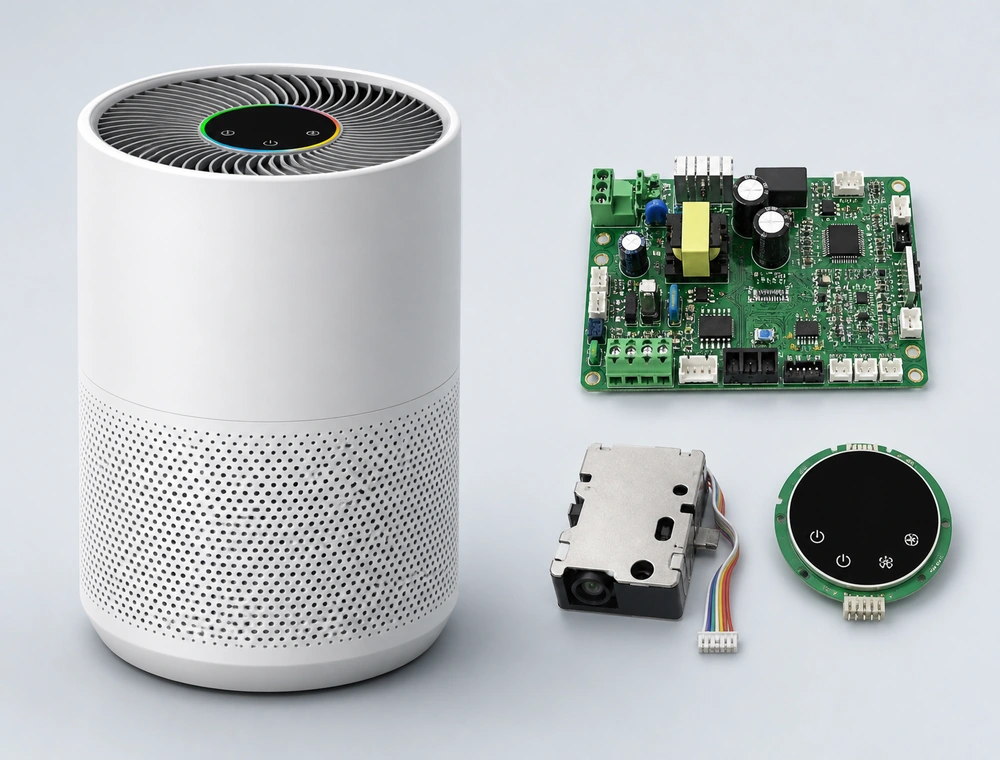
Multi-function Product Control
Coordinate sensing, user settings, loads, timing and connected functions through one defined state model.
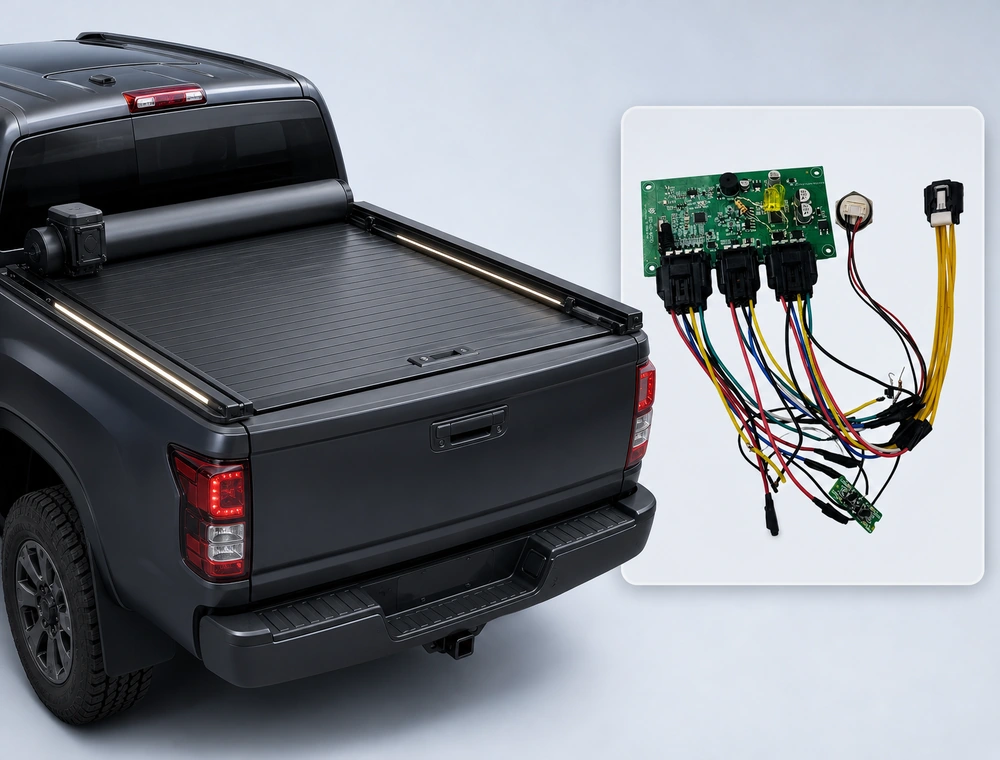
Machines & Control Units
Integrate motor movement, position feedback, protection and service behavior for product mechanisms.
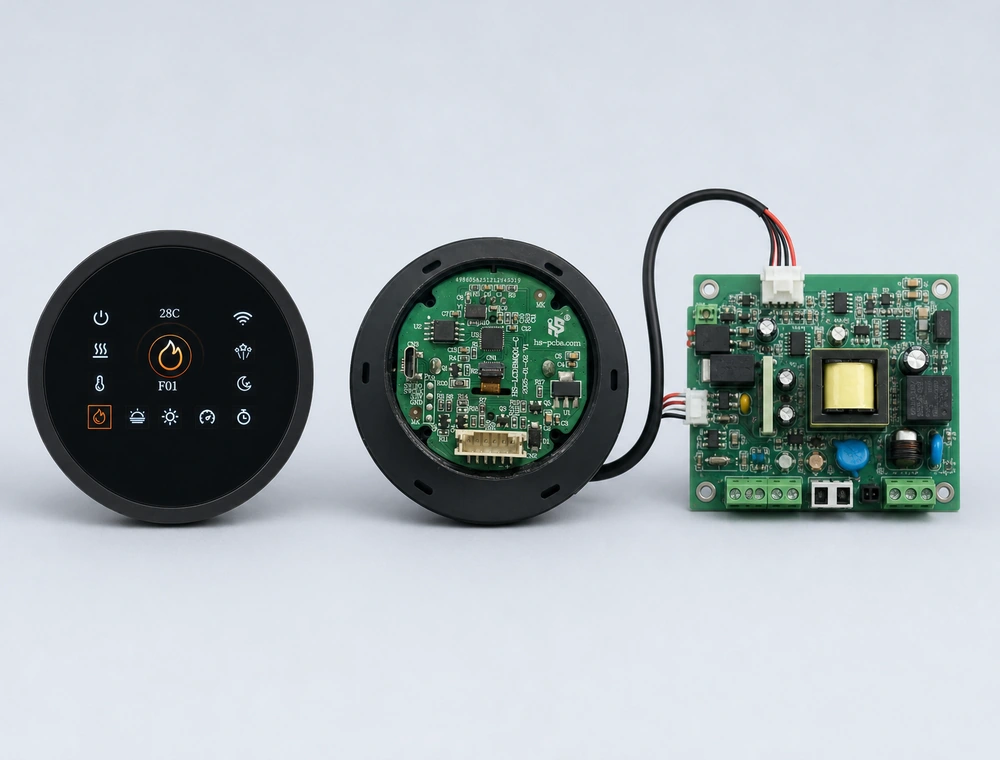
Displays & Control Panels
Connect knobs, touch, displays, indicators and product logic through a responsive embedded interface.
ENGINEERING TO PRODUCTION
Carry the control definition into repeatable production
The same requirements that guide hardware and firmware also shape programming, functional testing and release controls.
Requirements & Architecture
Define states, interfaces, electrical limits, enclosure constraints and production targets.
Prototype & Integration
Bring up the board and firmware with representative sensors, loads and user interfaces.
NPI & Validation
Close design, assembly, programming and functional-test risks through controlled builds.
Mass Production
Release approved revisions, programs and tests into a controlled repeatable process.
FAQ
Embedded Control Solution FAQs
Clear system inputs reduce unnecessary board revisions later in development.
What is an embedded control solution?
An embedded control solution combines a processor, input and output circuits, firmware and product interfaces to sense conditions, make decisions and control defined functions inside a product or piece of equipment.
What information is needed to start an embedded control project?
Useful inputs include the operating sequence, sensors, loads, user interfaces, communication requirements, electrical limits, enclosure constraints, abnormal behavior, compliance markets, existing files and target production volume.
How do you select an STM32 MCU for an embedded product?
The STM32 device is selected against processing needs, memory, peripherals, I/O count, communication, real-time behavior, power, package, cost, availability and the expected product lifecycle. A familiar device is not automatically the best fit for every product.
Can sensors, motors, heating and displays be controlled on one board?
They can be integrated when the power architecture, processor resources, I/O, thermal conditions and safety requirements support the complete product. The functions and their priorities must be defined as one system.
Do you develop embedded firmware with the hardware?
Embedded firmware can be developed alongside the hardware for control logic, interfaces, configuration, diagnostics and product behavior. The exact firmware scope and deliverables are confirmed for each project.
How is an embedded controller tested for production?
Testing may include programming, power checks, input simulation, output loading, communication, user-interface functions, fault states and product-specific functional sequences. The test plan is defined from the approved requirements.
STM32 CONTROL PLATFORM
Select the STM32 resources around the product
STM32 is treated as an engineering platform. Device family, peripherals, package, memory, lifecycle and production access are matched to the complete control requirement.
MCU Selection
Balance processing, memory, I/O, peripherals, package, cost, availability and lifecycle.
Power, Clock & Reset
Define stable rails, clock sources, reset behavior, watchdog strategy and startup states.
Sensor Acquisition
Coordinate ADC, timers, digital buses, filtering and calibration with the required signals.
PWM & Actuator Control
Use timers, PWM and drive interfaces for motors, heaters, valves, lighting and other loads.
Product Communication
Plan UART, I2C, SPI, CAN, RS485 or a wireless module around the system boundary.
Debug & Production Access
Provide programming, diagnostics, calibration and test access for NPI and repeatable builds.
The final STM32 part is confirmed after the control sequence, interfaces, real-time behavior and production lifecycle are understood.
Turn the product sequence into a clear STM32 control architecture
Share what the product must sense, decide, control and communicate. HS-PCBA can review the STM32 hardware, firmware interfaces and production path together.