
The garage is often the most neglected space in a residential or commercial building regarding climate control. It is a transitional zone that experiences extreme temperature fluctuations, high humidity, dust accumulation, and sometimes the presence of volatile chemical vapors from vehicles or solvents. Consequently, engineering a garage space heater PCBA requires a philosophy fundamentally different from designing electronics for a living room. In a controlled indoor environment, components are shielded from the elements; however, in a garage, the electronics are on the front lines. To ensure longevity and safety, the circuit assembly must be ruggedized to withstand “thermal shock”—the rapid expansion and contraction of materials as the heater cycles from sub-zero temperatures to high-intensity output in a matter of minutes.
Creating a reliable space heater control board for garage use involves a meticulous selection of industrial-grade components. Standard consumer-grade capacitors and resistors often fail when exposed to the moisture-laden air found in a typical workshop. When moisture settles on a standard circuit board, it can create dendritic growth—microscopic metallic bridges that cause short circuits. Therefore, a durable electric heater PCBA must be treated with advanced conformal coatings or potting compounds. These protective layers act as a hermetic seal, isolating the sensitive logic gates and power traces from the corrosive environment outside the heater’s chassis.
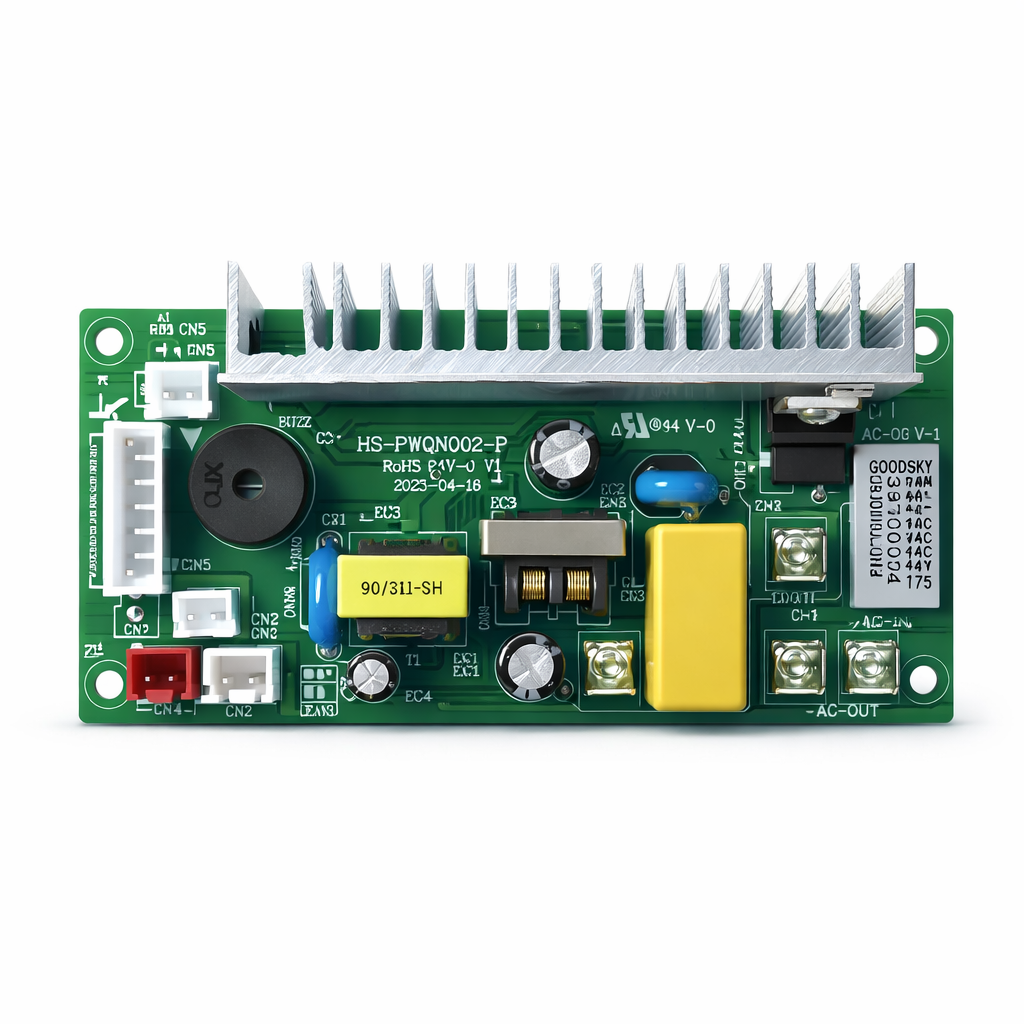
Overcoming Thermal Stress In The Garage Heater Control Board
The primary enemy of any garage heater control board is the very heat it is designed to manage. In a garage setting, these heaters are often high-wattage units intended to warm up large, uninsulated volumes of air quickly. This puts an immense thermal load on the PCB itself. If the board is not designed with adequate heat dissipation, the copper traces can delaminate, and solder joints can become brittle over time. To combat this, engineers utilize heavy copper weights—often double or triple the thickness of standard boards—to allow the electric heater PCBA to distribute thermal energy more evenly across its surface.
Furthermore, the physical layout of the garage heater control board must prioritize airflow around the high-voltage switching components. High-power relays and Silicon Controlled Rectifiers (SCRs) are typically the hottest points on the board. In a garage environment where dust is prevalent, these components can easily overheat if dust blankets their heat sinks. A well-engineered space heater control board for garage applications will often feature vertical mounting for large components to minimize dust settling and utilize thermal vias to “wick” heat away into the inner layers of the PCB, ensuring the board stays within its safe operating temperature even during a mid-winter blizzard.
Precision Logic And Safety In The Space Heater Control Board For Garage Use
Safety is the non-negotiable cornerstone of a space heater control board for garage environments. Because garages are often used for storage or as workshops, the risk of a heater coming into contact with flammable materials is significantly higher than in a bedroom. The garage space heater PCBA must therefore integrate a multi-layered safety logic. This includes tip-over protection, overheat sensors (thermistor inputs), and flame-retardant PCB substrates. The software running on the microcontroller must be robust enough to handle “dirty” power—voltage spikes and sags that are common in garage circuits where heavy power tools like saws and compressors are frequently cycling on and off.
To provide a truly premium experience, modern garage space heater PCBA designs now incorporate smart sensors. These sensors can detect if a filter is clogged with sawdust or if the airflow is obstructed, automatically throttling the heating element control board to prevent a fire hazard. This level of “active” safety is what separates professional-grade garage equipment from low-cost alternatives. By embedding logic that can “predict” a failure before it happens, the control board becomes a silent guardian of the property, providing peace of mind to the homeowner or facility manager.
Optimizing The Heating Element Control Board For Efficient Energy Transfer
At the end of the day, the efficiency of a heater is determined by how effectively it manages the power sent to the coils. The heating element control board is the gatekeeper of this energy. In a garage, where energy costs can climb quickly during the winter months, precision modulation is essential. Instead of a simple “On/Off” click-clack relay, advanced electric heater PCBA designs utilize Pulse Width Modulation (PWM) or zero-crossing switching. This allows the heater to provide a steady, consistent flow of warmth rather than blast-furnace heat followed by cold drafts.
This modulation also extends the life of the heating element itself. By reducing the “thermal cycling” of the heating coils—preventing them from getting red-hot and then cooling down to room temperature repeatedly—the heating element control board prevents the metal from fatiguing. For the end-user, this means the heater will last for decades rather than just a few seasons. The engineering challenge lies in ensuring the switching components on the garage space heater PCBA can handle this rapid modulation without generating excessive electromagnetic interference (EMI), which could disrupt Wi-Fi signals or radio reception in the garage.
Material Selection And Longevity Of The Electric Heater PCBA
When we talk about the longevity of an electric heater PCBA, we are talking about the quality of the raw materials. In the harsh environment of a garage, a standard FR-4 fiberglass substrate might not be enough. Designers often opt for High-Tg (Glass Transition Temperature) materials that remain rigid and stable even at extreme temperatures. This prevents the board from warping, which is a common cause of cracked solder joints in high-heat applications. Additionally, the use of lead-free, high-silver-content solder can improve the mechanical strength of the connections, ensuring that the garage heater control board can withstand the vibrations of the heater’s fan motor.
The final step in creating a durable electric heater PCBA for a garage is the environmental testing phase. A reputable manufacturer will subject the space heater control board for garage use to accelerated aging tests. This includes humidity chambers, salt-spray tests (to simulate coastal or salted-road environments), and thousands of power-on/off cycles. Only by pushing the electronics to their breaking point in the lab can engineers ensure they will never reach that point in the customer’s garage. Through this combination of ruggedized materials, intelligent safety logic, and superior thermal management, the modern garage heater becomes a masterpiece of industrial electronics, standing up to the cold, the dust, and the passage of time.