
The evolution of sleep-assistive technology has moved remarkably fast, transitioning from passive insulation to active, intelligent thermal management. At the forefront of this movement is the shift from electric-wire heating to hydronic systems, which circulate warmed water through a network of soft medical-grade tubing. However, the true innovation lies within the “brain” of these units: the voice-activated water heating blanket pcba. This specialized electronic architecture allows for a completely hands-free user experience, catering to a modern lifestyle where convenience and accessibility are paramount. By integrating advanced digital signal processing and high-sensitivity microphone arrays, the modern control system can identify and execute complex thermal commands, transforming a traditional bedding accessory into a responsive, high-tech wellness device.
Implementing a voice-activated water heating blanket pcba requires a sophisticated balance of power management and acoustic engineering. The circuit board must process ambient sound, filter out background noise, and recognize specific trigger words—all while managing the heavy lifting of heating water and driving a circulation pump. This integration of artificial intelligence at the edge ensures that the user can adjust their sleep environment without ever having to reach for a remote or sit up in the dark. For the elderly or those with limited mobility, this technology is more than a luxury; it is a vital tool for independent living, providing a sense of control and comfort that was previously labor-intensive.
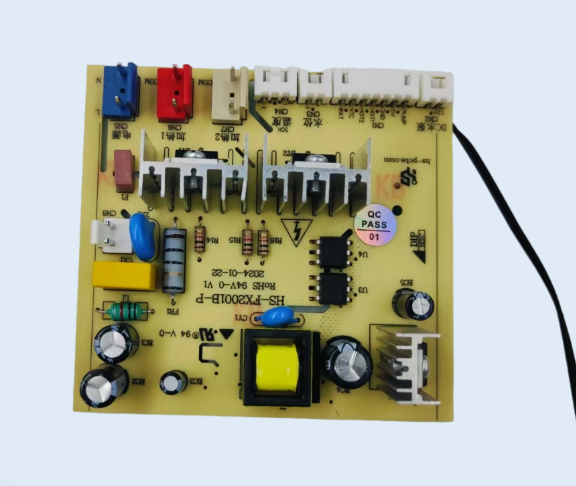
Technical Integration Of The Audio Prompt Water Heating Blanket PCB
A high-performance audio prompt water heating blanket pcb does not just listen; it speaks back. This bidirectional communication is achieved through the integration of a dedicated speech synthesis chip and a digital-to-analog converter (DAC) that drives a localized speaker. When a user interacts with the system, the audio prompt water heating blanket pcb provides immediate, clear confirmation of the current status. For example, if a user asks to increase the temperature to thirty-eight degrees, the system will verbally confirm the change. This provides essential feedback in a dark bedroom environment, eliminating the need for bright, sleep-disrupting LED screens or the fumbling for a smartphone app in the middle of the night.
The development of the audio prompt water heating blanket pcb also involves meticulous shielding to prevent electromagnetic interference. Because the board manages both high-current heating elements and low-voltage audio signals, any electrical noise could result in distorted feedback or “ghost” voice triggers. Engineers utilize multi-layer PCB designs and localized grounding planes to ensure that the audio remains crisp and the voice recognition remains accurate. This level of technical refinement ensures that the blanket operates silently in the background, only making its presence known when the user specifically requests an adjustment or when the system needs to provide a critical safety alert.
The Intelligence Of The Voice Feedback Water Circulation Heater Control Board
At the heart of the hydronic unit sits the voice feedback water circulation heater control board, which manages the complex physics of fluid dynamics and thermal transfer. Unlike traditional heaters, a water-based system must monitor the flow rate, the pressure of the pump, and the temperature of the water at both the intake and the outlet. The voice feedback water circulation heater control board utilizes a Proportional-Integral-Derivative (PID) algorithm to ensure that the temperature remains perfectly stable. If the system detects an anomaly—such as a kink in the hose or a low water level—it uses its voice feedback capabilities to inform the user exactly what is wrong, rather than just flashing a cryptic error code.
This proactive communication is what makes the voice feedback water circulation heater control board a leader in safety and user experience. It can gently announce, “Please add water to the reservoir,” or “System is entering sleep mode,” providing a layer of human-like interaction that builds trust with the consumer. Furthermore, the board is designed with “Scene Memory,” allowing it to store voice-triggered presets for different users. Whether it is a “Deep Sleep” setting that gradually cools down throughout the night or a “Rapid Warm-up” for cold winter evenings, the control board manages these transitions with surgical precision and clear vocal confirmation.
Advancing Connectivity With A Smart Heated Blanket PCBA
In the interconnected modern home, the smart heated blanket pcba serves as a vital node in the bedroom ecosystem. While voice activation provides immediate local control, the “smart” aspect refers to the board’s ability to sync with broader smart home hubs and mobile applications. A professional-grade smart heated blanket pcba is equipped with dual-band Wi-Fi and Bluetooth Low Energy (BLE) modules, allowing it to receive over-the-air (OTA) firmware updates. This means that the voice recognition algorithms can be improved over time, and new features or languages can be added without the user ever needing to replace the physical hardware.
The smart heated blanket pcba also acts as a data collector, monitoring sleep patterns based on temperature adjustments and usage duration. This data can be visualized on a smartphone app, helping users understand how their thermal environment affects their sleep quality. By integrating with weather APIs, the smart board can even suggest an optimal temperature based on the local outdoor forecast. This level of predictive intelligence transforms the heating blanket from a reactive heater into a proactive sleep optimizer, ensuring that the user always climbs into a bed that is perfectly calibrated for the current environment.
Safety And Reliability Of The Water Heating Blanket Control Board
Safety is the non-negotiable foundation of any water heating blanket control board. Because these devices are used while the consumer is unconscious and in close proximity to water and electricity, the PCBA must feature multiple layers of hardware-level protection. A high-quality water heating blanket control board includes an independent watchdog timer that can reset the processor if it hangs, as well as physical thermal fuses that cut power if the water temperature exceeds a safe threshold. The board is also treated with a moisture-resistant conformal coating to prevent short circuits caused by humidity or accidental spills.
For manufacturers, sourcing a water heating blanket control board that meets international safety certifications is essential for global market entry. The board must undergo rigorous testing for electromagnetic compatibility (EMC) and surge protection. Additionally, the pump control logic is designed to be ultra-quiet, utilizing sine-wave driving technology to minimize vibrations. This ensures that the only thing the user hears is the occasional soft voice prompt, rather than the hum of a mechanical pump. By focusing on both the invisible safety features and the highly visible voice-interface features, the control board provides a comprehensive solution for the luxury bedding market.