
The landscape of domestic thermal comfort is witnessing a significant shift toward hydronic systems, which replace traditional electric wires with the gentle, consistent warmth of circulating water. As this market matures, the demand for sophisticated user interfaces and precise control mechanisms has never been higher. At the forefront of this mechanical elegance is the rotary encoder heating controller pcb, a specialized electronic assembly designed to provide users with a tactile, high-precision method of adjusting their sleep environment. Unlike standard push-buttons that can feel imprecise or membrane switches that lack durability, the rotary encoder offers a professional-grade “click” feedback that allows for granular temperature adjustments, making it the preferred choice for premium water-based heating units.
The integration of a rotary encoder heating controller pcb into a hydronic system represents a marriage of classic haptic feedback and modern digital processing. The encoder works by converting the angular position or motion of a shaft into an analog or digital signal, which the onboard microcontroller then interprets to adjust the water temperature or pump speed. For the end-user, this translates to an intuitive experience where a simple turn of a dial can raise the warmth by exactly one degree, providing a sense of control and quality that defines the luxury bedding sector. This technical transition is not just about aesthetics; it is about providing a reliable, long-lasting interface that can survive thousands of rotations over the product’s lifetime.
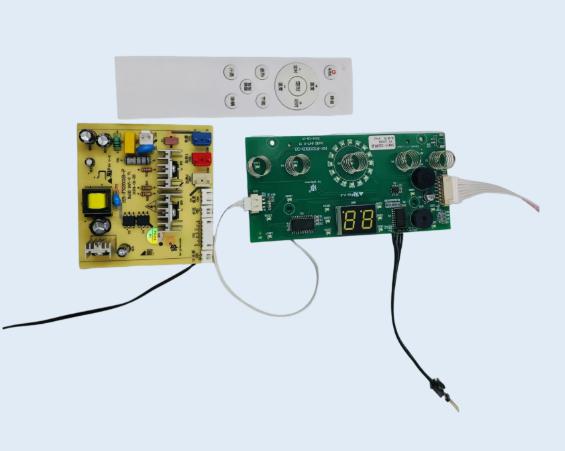
Technical Precision Of The Rotary Encoder Heated Blanket PCBA
In the engineering of a rotary encoder heated blanket pcba, the primary challenge lies in de-bouncing the mechanical signals and ensuring that the digital interface remains responsive even during rapid adjustments. A high-quality encoder board utilizes an incremental or absolute encoder paired with a dedicated interrupt-driven software architecture. This ensures that every “detent” or click of the dial is registered by the system without lag. Furthermore, the rotary encoder heated blanket pcba often incorporates a “push-to-select” function within the same shaft, allowing the user to toggle between different menus—such as timer settings, zone control, or child lock—without needing additional buttons that would clutter the device’s exterior design.
The layout of the rotary encoder heated blanket pcba must also account for electromagnetic compatibility (EMC). Since the rotary dial is a primary point of human contact, the board must be shielded against electrostatic discharge (ESD) that can occur in dry bedroom environments. Engineers implement TVS diodes and filtering capacitors near the encoder pins to shunt any static electricity away from the sensitive microcontroller. This level of technical fortification ensures that the heating unit remains operational and safe, providing the manufacturer with a robust solution that minimizes the risk of electronic failure and enhances the brand’s reputation for reliability in the competitive sleep-tech market.
Fluid Management With Water Circulation Heated Blanket PCBA Technology
While the user interacts with the dial, the water circulation heated blanket pcba is busy managing the complex thermodynamics of the hydronic system. This board serves as the power hub for the entire unit, driving the high-torque water pump and the ceramic heating element. A professional water circulation heated blanket pcba utilizes pulse-width modulation (PWM) to control the pump speed, ensuring that water moves silently through the blanket’s internal tubing. Silence is a critical performance metric in the bedroom; therefore, the PCBA is designed with low-noise motor drivers that eliminate the “hum” often associated with cheaper water heaters.
The water circulation heated blanket pcba must also manage the safety logic required for fluid systems. This includes monitoring for water level through capacitive sensors and detecting flow blockages through pressure transducers. If the system detects that the water is not circulating—perhaps due to a kink in the external hose—the PCBA must immediately cut power to the heater to prevent localized overheating. This real-time monitoring is what makes hydronic systems inherently safer than traditional electric blankets, as the heat source is located in an external, monitored reservoir rather than inside the bedding itself.
Enhancing Efficiency With Hydronic Heating Blanket PCBA Solutions
Efficiency in a hydronic heating blanket pcba is measured by how quickly it can reach the target temperature and how effectively it can maintain that heat with minimal energy consumption. To achieve this, modern boards implement a sophisticated PID (Proportional-Integral-Derivative) algorithm. When the user turns the rotary dial to a specific temperature, the hydronic heating blanket pcba calculates the energy required to reach that setpoint without overshooting. As the water nears the desired warmth, the power is gradually throttled down, resulting in a stable thermal curve that prevents the “cycling” effect of turning on and off, which can be disruptive to deep sleep.
Furthermore, the hydronic heating blanket pcba often supports eco-modes and smart-timer functions. These features are designed to lower the temperature during the middle of the night—when the human body naturally cools down during REM sleep—and gradually raise it again before the morning alarm. This not only provides a more natural sleep cycle but also significantly reduces the electricity used over an eight-hour period. By optimizing the thermal delivery through advanced PCBA logic, manufacturers can offer a product that is both environmentally conscious and exceptionally comfortable for the modern consumer.
Safety Standards In A Temperature-Controlled Heated Blanket PCBA
The final layer of engineering excellence is found in the temperature-controlled heated blanket pcba safety architecture. Because these devices operate for long durations while the user is asleep, they must adhere to the strictest international safety standards, such as UL and CE. A high-grade temperature-controlled heated blanket pcba features redundant temperature sensors: one in the heating tank and one in the return line. This dual-monitoring system ensures that if one thermistor fails, the secondary sensor can still trigger a safety shutdown.
Beyond thermal protection, the temperature-controlled heated blanket pcba includes sophisticated power management circuitry. This includes surge protection and a high-voltage isolation barrier that separates the water-exposed components from the user-facing interface. Conformal coating is also applied to the PCB to protect against the humidity and moisture common in water-based systems. By focusing on these invisible but vital details, the OEM partner provides a control system that is as safe as it is intuitive, allowing the end-user to rest easy knowing their comfort is managed by a reliable and intelligent electronic partner.