
The landscape of domestic and industrial automation has been fundamentally altered by the emergence of highly integrated wireless microcontrollers. At the forefront of this shift is the ESP32, a versatile chipset that has transitioned from a favorite of prototyping enthusiasts to a cornerstone of industrial-grade hardware. For global brands seeking to modernize their product lines, partnering with a specialist in oem esp32 control board pcba fabrication is no longer just a manufacturing choice but a strategic imperative. The ability to embed robust, cloud-ready intelligence into a traditional appliance transforms a static machine into a dynamic participant in the Internet of Things ecosystem.
Designing these control systems requires a sophisticated understanding of how high-frequency wireless signals interact with the power electronics necessary to drive motors, heating elements, and compressors. A professional manufacturing partner does not merely assemble components; they engineer a cohesive system where the ESP32 acts as the central nervous system. This involves meticulous circuit design that prioritizes signal integrity and minimizes electromagnetic interference, ensuring that the smart functionality of an appliance remains as reliable as its mechanical core. As we move further into 2026, the complexity of these boards continues to grow, requiring advanced surface mount technology and rigorous quality control to meet the demands of a global market.
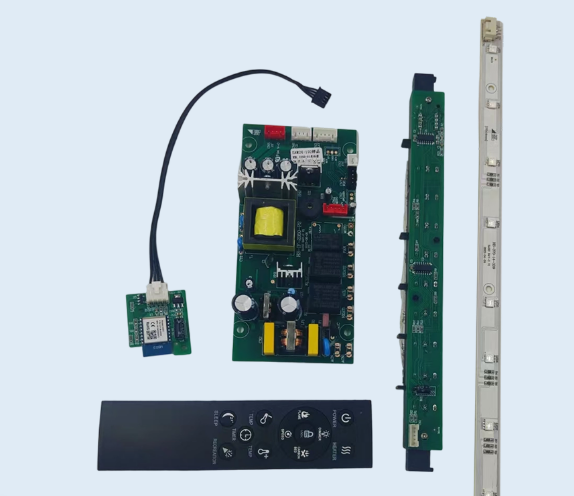
Technical Synergy In The ESP32 Wi-Fi Bluetooth Control Board For Multi-Protocol Networking
The primary appeal of the ESP32 lies in its native support for dual-mode wireless communication. An esp32 wi-fi bluetooth control board offers a unique dual-pathway for data, allowing for seamless user interaction and background cloud synchronization. Wi-Fi connectivity enables the appliance to maintain a constant link to remote servers for OTA firmware updates, remote diagnostics, and big data harvesting. Simultaneously, the Bluetooth Low Energy component provides a local, high-speed interface for initial device provisioning and direct smartphone control in environments where local networks may be unstable or unavailable.
The layout of such a board is a masterclass in electronic compromise. Engineers must balance the high-speed data traces required by the processor with the high-current paths needed for appliance operation. A reputable esp32 control board oem facility focuses heavily on the antenna design and the ground plane configuration. If the wireless module is shielded improperly or placed too close to switching power supplies, the resulting noise can severely degrade the connection range. By utilizing multi-layer PCB stack-ups and strategic component placement, manufacturers can ensure that the wireless performance remains peak, even when the board is buried deep within a metal-chassis appliance.
Reliability And Durability Standards For The ESP32 Appliance Control Board In Harsh Conditions
When developing an esp32 appliance control board, manufacturers must account for environmental stressors that standard consumer electronics rarely face. Appliances are often subjected to extreme thermal cycles, high humidity, and physical vibrations. For instance, a control board situated inside a smart dishwasher or a commercial refrigerator must be resilient against moisture ingress and chemical exposure. To combat these issues, high-end PCBA facilities employ advanced conformal coating processes, applying a microscopic protective layer over the entire assembly to prevent oxidation and short circuits.
Furthermore, the longevity of the components surrounding the ESP32 is of paramount importance. Industrial-grade capacitors, heat-resistant resins, and reinforced solder joints are used to ensure that the electronics do not fail before the mechanical lifespan of the appliance is reached. A dedicated smart appliance esp32 pcba factory understands that a single component failure in the field can result in expensive recalls and damage to a brand’s reputation. Therefore, the manufacturing process includes intensive “burn-in” testing, where boards are operated under maximum load and temperature for extended periods to weed out any latent defects before the final product is shipped to the assembly line.
Customization And Edge Intelligence Within The OEM ESP32 Control Board PCBA Framework
The shift toward edge computing has placed new demands on the processing power of integrated control systems. An oem esp32 control board pcba is capable of doing much more than simply relaying data to the cloud; it can perform real-time sensory analysis and autonomous decision-making. This local intelligence is vital for safety-critical applications, such as a smart oven that can detect an abnormal temperature spike and shut down locally without needing to wait for a command from a remote server. This autonomy ensures that the appliance remains “smart” and safe even if the home internet connection fails.
To facilitate this, the PCBA must be designed with an array of peripheral interfaces, including I2C, SPI, and high-speed UART ports, allowing for the integration of specialized sensors for gas detection, motion, or infrared imaging. The manufacturing partner plays a vital role in this ecosystem by providing a “turnkey” solution that includes hardware abstraction layers and pre-flashed bootloaders. This level of vertical integration allows the original equipment manufacturer to focus on the user-facing software and industrial design, confident that the underlying hardware is optimized for the specific demands of the appliance’s firmware.
Future-Proofing Global Supply Chains With A Smart Appliance ESP32 PCBA Factory Partner
In the modern manufacturing world, the stability of the supply chain is just as important as the quality of the engineering. A specialized smart appliance esp32 pcba factory offers more than just production capacity; it provides a gateway to a secure and vetted ecosystem of component suppliers. In an era where silicon availability can fluctuate, having a partner with direct ties to major semiconductor distributors ensures that production schedules remain on track. This reliability is the foundation upon which global product launches are built.
Moreover, as international regulations regarding energy efficiency and electronic waste become more stringent, the role of the esp32 control board oem expands into the realm of compliance. Modern boards must be designed for easy recycling and must adhere to RoHS and REACH standards. By utilizing lead-free soldering and eco-friendly substrates, manufacturers are helping brands meet their sustainability goals while still delivering cutting-edge technology. The combination of ethical manufacturing, technical precision, and wireless expertise makes the ESP32-based control board the definitive choice for the next generation of smart appliances.
By focusing on these core pillars—connectivity, reliability, and edge intelligence—manufacturers are not just building circuits; they are creating the digital infrastructure that will define the modern home and workplace. The partnership between an appliance brand and their PCBA manufacturer is the primary engine of innovation in the IoT space, ensuring that every “smart” device is built on a foundation of hardware excellence that is designed to last.