
The global appliance industry is currently navigating a pivotal transition where traditional mechanical utility is being replaced by digital intelligence. As homeowners and industrial operators alike demand greater connectivity, the hardware driving these innovations has become the most critical asset in a manufacturer’s portfolio. At the forefront of this shift is the OEM ESP32 control board, a versatile and powerful computing platform that has redefined the standards for wireless communication and automated logic. By integrating a high-performance dual-core processor with native Wi-Fi and Bluetooth capabilities, this control board allows brands to transform standard machines into responsive, data-driven assets that participate in a wider ecosystem of smart connectivity.
Engineering a smart appliance control board with esp32 involves a sophisticated marriage of power electronics and radio frequency (RF) design. Unlike standard consumer electronics, large-scale appliances operate in environments characterized by high electrical noise, physical vibration, and varying thermal loads. Consequently, the development of a professional-grade esp32 appliance control pcba requires more than just functional code; it demands a robust physical architecture capable of maintaining signal integrity and operational safety over a decade of use. This strategic integration is what enables the modern home to function as a unified, intelligent environment.
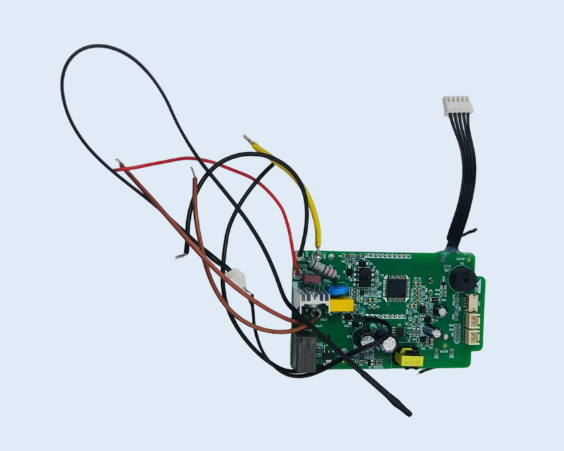
Technical Superiority Of The OEM ESP32 Control Board Architecture
The primary reason for the widespread adoption of the oem esp32 control board in the global market is its unique silicon architecture. The ESP32 chip is designed with a dual-core Xtensa® 32-bit LX6 microprocessor, which allows for a high degree of task segregation. In an appliance setting, this means that one core can be dedicated to real-time safety functions—such as monitoring heating elements or motor speeds—while the second core handles the heavy computational load of Wi-Fi encryption and cloud communication. This hardware-level separation ensures that the appliance remains responsive and safe, even if the wireless network experiences latency or high traffic.
Furthermore, the esp32 control board oem solutions provide a rich array of integrated peripherals that reduce the need for external components. From capacitive touch sensors for sleek user interfaces to high-speed analog-to-digital converters for precise sensor reading, the ESP32 acts as an all-in-one controller. This integration significantly lowers the complexity of the esp32 iot pcba, resulting in a more compact design and a reduced bill of materials. For the manufacturer, this translates to lower production costs and a more reliable product, as there are fewer physical traces and connectors that could fail over time.
Designing The Smart Appliance Control Board With ESP32 For Harsh Environments
A smart appliance control board with esp32 must be engineered to survive where other electronics would fail. Kitchens and laundry rooms are notoriously difficult environments for Printed Circuit Board Assemblies (PCBAs) due to the presence of steam, grease, and temperature fluctuations. To address these challenges, a professional esp32 appliance control pcba is typically built using high-quality FR-4 substrates with superior thermal resistance. Designers often implement wide copper traces and specialized thermal vias to dissipate the heat generated by power switching components, ensuring that the ESP32 chip itself remains within its optimal operating temperature range.
Protection against moisture and airborne contaminants is another critical factor in the longevity of the esp32 iot pcba. High-end manufacturers apply conformal coatings—thin, protective chemical layers—over the finished assembly. These coatings act as a barrier against humidity and dust while remaining transparent to the RF signals emitted by the onboard antenna. This level of environmental ruggedization is what allows an oem esp32 control board to function reliably in a dishwasher or a convection oven, providing the “smart” features that consumers expect without compromising the physical durability of the appliance.
Advanced Connectivity And The ESP32 IoT PCBA Ecosystem
The true power of the esp32 iot pcba lies in its ability to facilitate seamless communication between the device and the cloud. Modern smart appliances are no longer isolated units; they are nodes in a data network. An esp32 control board oem solution supports a wide variety of communication protocols, including MQTT, HTTP, and WebSockets, which are essential for real-time monitoring and control. This allows for features such as remote diagnostics, where the appliance can send health reports to a service center, or energy management, where a washing machine might delay its cycle until electricity rates are lower.
Security is the cornerstone of this connectivity. The esp32 iot pcba includes hardware-accelerated encryption engines for AES, SHA, and RSA, ensuring that every data packet transmitted over the air is protected from interception. During the manufacturing of a smart appliance control board with esp32, unique cryptographic keys are injected into the chip’s secure storage. This prevents unauthorized firmware from being loaded and ensures that the appliance cannot be compromised by malicious actors. By building security into the very silicon of the oem esp32 control board, manufacturers provide a foundation of trust for the end-user.
Precision Manufacturing Standards For ESP32 Appliance Control PCBA
The transition from a prototype to a mass-produced esp32 appliance control pcba requires a rigorous quality control framework. Industrial-scale manufacturing involves automated optical inspection (AOI) and X-ray testing to verify the integrity of every solder joint. Because the oem esp32 control board often carries high-voltage current to drive motors or compressors, even a microscopic fracture in a solder connection could lead to a catastrophic failure. Professional manufacturers also conduct functional circuit testing (FCT) on every unit, simulating real-world operational loads to ensure that the board meets the exact specifications of the client.
Furthermore, compliance with international standards such as UL, CE, and RoHS is a non-negotiable requirement for the esp32 appliance control pcba. These certifications guarantee that the electronics meet strict fire safety and environmental impact guidelines. By partnering with a factory that specializes in esp32 control board oem production, brands can navigate the complex regulatory landscape more efficiently. The manufacturer’s expertise in radio frequency calibration ensures that the Wi-Fi and Bluetooth signals comply with local telecommunications laws, preventing interference with other household devices and ensuring a smooth user experience worldwide.