
The intersection of fluid dynamics and digital electronics has birthed a new era of interior ambiance, moving far beyond the flat, two-dimensional LED screens of the past. The most significant breakthrough in this space is the development of the ultrasonic atomization fireplace pcba, a specialized control system that replaces traditional heat-based fire simulation with a cool-to-the-touch, hyper-realistic water vapor effect. By utilizing high-frequency sound waves to fracture water molecules into a fine mist, and then illuminating that mist with precision-controlled optics, manufacturers can now create a three-dimensional flame that mimics the organic movement of real fire. At the heart of this “magic” is a complex array of sensors and microprocessors that manage the delicate balance between water levels, ultrasonic frequencies, and airflow.
The Science Behind the Ultrasonic Atomization Fireplace PCBA
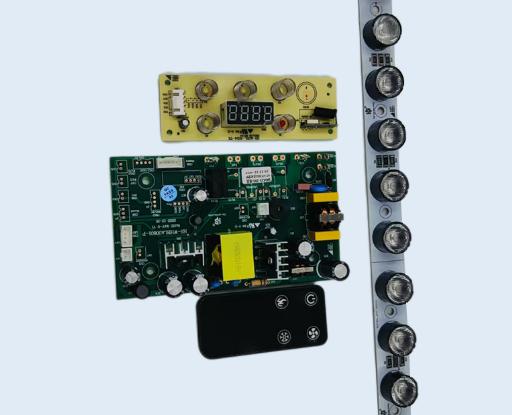
To understand the sophistication of a modern water vapor hearth, one must look at the foundational engineering of the ultrasonic atomization fireplace pcba. Unlike standard electric heaters, this board must manage a piezoelectric transducer—a ceramic disc that vibrates at ultrasonic speeds. This vibration creates a high-pressure zone that forces water into a microscopic mist. The PCBA is responsible for regulating the specific voltage and frequency sent to these transducers; if the frequency is off by even a small margin, the mist density will be inconsistent, leading to a “patchy” or unrealistic flame appearance.
The ultrasonic atomization fireplace pcba also acts as a safety supervisor. Because these systems rely on a constant water supply, the board must interface with capacitive or optical water level sensors. If the reservoir runs dry, the PCBA must instantly cut power to the ultrasonic discs to prevent thermal damage. This level of integrated logic ensures that the fireplace remains a low-maintenance, high-reliability feature in luxury residential and commercial settings. Furthermore, modern boards are now designed with anti-corrosion coatings to protect the sensitive circuitry from the humid environment inherent to water-mist technology.
Achieving Visual Depth With the Ultrasonic 3D Flame Effect Control Board
The primary appeal of a mist-based fireplace is its dimensionality. A standard ultrasonic 3d flame effect control board is engineered to provide a 360-degree visual experience, allowing the “flames” to be viewed from any angle without losing their realism. This is achieved through the precise coordination of a high-speed fan system and a multi-channel LED array. The control board must manage the fan’s RPM with extreme granularity; if the airflow is too strong, the mist dissipates too quickly; if it is too weak, the “flames” appear stagnant and heavy.
By utilizing an ultrasonic 3d flame effect control board, designers can program “flutter” patterns into the airflow, simulating the natural turbulence of a wood fire. The board synchronizes these air pulses with light intensity changes, creating the illusion of rising heat and flickering embers. This synergy between hardware and software is what allows the mist to take on a lifelike quality, rising and swirling in a way that light reflected off a rotating mirror could never replicate. For the end-user, the result is a mesmerizing focal point that provides the psychological comfort of a hearth without any of the associated fire hazards or air quality concerns.
Precision Timing in the Ultrasonic Atomization Control Board
The fluid dynamics of water vapor are incredibly sensitive to environmental changes such as room temperature and humidity. To counteract these variables, a high-end ultrasonic atomization control board utilizes feedback loops from integrated sensors. These sensors monitor the density of the mist as it leaves the transducer chamber. If the ambient air is particularly dry, the control board can increase the power to the atomizers to maintain a consistent visual “weight” to the flames.
This ultrasonic atomization control board also manages the “startup” and “shutdown” sequences which are vital for equipment longevity. Upon activation, the board must prime the ultrasonic discs and gradually ramp up the fan speed to prevent a sudden “burst” of moisture that could condense on the glass or decorative logs. During shutdown, the board often enters a “dry-out” mode, where the fans continue to run for several minutes after the mist has stopped, ensuring that no residual moisture remains in the internal ducts where it could lead to mineral buildup or mold. This level of automated care is what separates a professional-grade PCBA from hobbyist-level components.
Enhancing Realism With the Ultrasonic Flame Simulation Control PCBA
The “flame” we see in a mist fireplace is essentially a screen made of water, and the ultrasonic flame simulation control pcba is the projector and director combined. Modern simulation logic allows for a “dynamic spectrum” of colors. While basic models might only offer orange, an advanced ultrasonic flame simulation control pcba can blend RGB colors to create “gas-blue” bases or “white-hot” tips within the same flame column.
Beyond color, the board manages the “texture” of the flame. By varying the ultrasonic pulse width, the board can create a soft, languid flame for a relaxed atmosphere or a sharp, energetic flicker for a more dramatic effect. This simulation is so precise that it can even account for the “log-interaction” effect, where the light intensity increases in specific areas to mimic the glowing pockets of air found between real burning timber. This attention to detail is why ultrasonic flame simulation control pcba technology has become the standard for five-star hotels and luxury lounges where the authenticity of the “experience” is the highest priority.
Versatility of the 3D Mist Flame Effect Control PCBA
As fireplaces become larger and more architectural, the 3d mist flame effect control pcba must support modularity. In long, linear “ribbon” fireplaces, multiple PCBAs are often linked in a master-slave configuration. This ensures that the mist generation and lighting across a six-foot-long fireplace are perfectly synchronized. If one section of the mist rises slower than another, the illusion is broken. The 3d mist flame effect control pcba utilizes high-speed communication protocols to ensure that every transducer and LED across the entire length of the unit acts as a single, cohesive organism.
Furthermore, the 3d mist flame effect control pcba is increasingly being integrated with smart home ecosystems. Users can now adjust the “height” of their mist flames or change the color temperature via voice commands or mobile apps. This connectivity allows for “seasonal” presets, where the fireplace might emit a warm, crackling amber light in the winter and a cool, ethereal blue mist in the summer, serving as an evaporative humidifier while providing a tranquil visual. This versatility ensures that the ultrasonic fireplace remains a year-round centerpiece of the home, proving that the future of the hearth is not in burning carbon, but in the intelligent manipulation of water and light.