
The architectural landscape of the modern home is undergoing a profound sensory shift, moving away from static heating elements toward dynamic, lifelike installations that prioritize both safety and aesthetic wonder. At the forefront of this movement is the water vapor hearth—a sophisticated system that utilizes the physics of evaporation and light to simulate a burning fire. The technical heart of these systems is the ODM water vapor fireplace control board, a specialized piece of hardware that manages the delicate interplay between fluid dynamics and optical projection. By transitioning from traditional heat-based simulation to a cold-mist approach, manufacturers are creating a “3D” visual experience that is indistinguishable from real flames but remains entirely cool to the touch. This evolution is driven by high-frequency oscillation and precision-tuned light arrays, all orchestrated by a central processing unit designed for high-performance domestic environments.
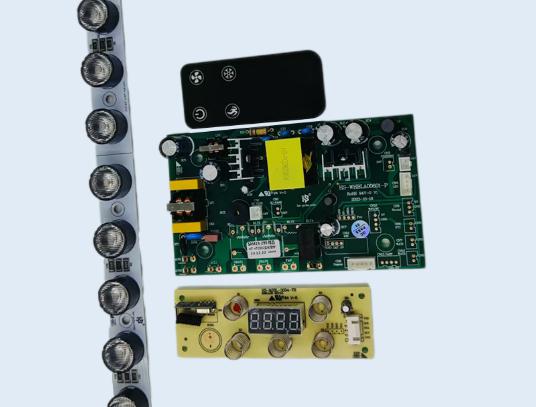
The Engineering Foundation of the ODM Water Vapor Fireplace Control Board
Designing a modern fireplace for the global market requires a balance of reliability and innovation, a task perfectly suited for an ODM water vapor fireplace control board. Unlike standard electric fireplace controllers, which primarily manage resistive heating coils, the ODM board must govern a complex array of piezoelectric transducers. These transducers vibrate at millions of cycles per second to shatter water molecules into a microscopic fog. The control board must provide a highly stable, low-noise power supply to these components to ensure the mist density remains constant across the entire length of the unit.
Furthermore, a professional ODM water vapor fireplace control board acts as a comprehensive safety manager. Because water and electronics are contained within the same chassis, the board is engineered with moisture-resistant coatings and advanced leak-detection circuits. It interfaces with capacitive water sensors to monitor reservoir levels, ensuring that the ultrasonic discs never run dry, which would lead to mechanical failure. This level of integrated oversight is what makes the ODM solution the preferred choice for high-end hospitality and residential projects where “set-and-forget” reliability is the standard.
Achieving Visual Depth with the 3D Steam Flame Effect Control Board
The primary challenge in simulating fire is moving beyond the flat, two-dimensional look of LED screens. This is where the 3D steam flame effect control board excels. By utilizing a high-speed microprocessor, the board coordinates the vertical rise of the water vapor with a series of high-output RGB light channels. The light is projected into the mist at specific angles, catching the individual water droplets to create a three-dimensional “body” of fire. Because the mist is translucent and swirling, the light creates depth, shadows, and highlights that mimic the organic movement of real oxygen-fed flames.
An advanced 3D steam flame effect control board also manages the “flutter” of the flame. By varying the intensity of the light in synchronization with subtle changes in fan speed, the board creates the illusion of heat turbulence. This ensures that the “fire” does not look like a static glowing cloud, but rather a dancing, flickering energy source. For the end-user, the result is an immersive centerpiece that can be viewed from any angle—even from directly above—without breaking the illusion of a volumetric, three-dimensional fire.
Precision Atomization via the Ultrasonic Mist Fireplace PCBA
The “fuel” for a water vapor fireplace is the mist itself, and the ultrasonic mist fireplace pcba is the engine that produces it. This specialized board is tuned to the specific resonant frequency of the ultrasonic transducers used in the unit. If the frequency drifts even slightly, the mist becomes too heavy, causing it to fall and condense on the decorative logs rather than rising into the air. The PCBA utilizes a feedback loop to maintain this frequency regardless of water temperature or mineral content, ensuring a “fine-dry” mist that leaves no residue on surrounding furniture.
Moreover, the ultrasonic mist fireplace pcba manages the gradual ramp-up of power during the startup sequence. This prevents a sudden burst of moisture that could overwhelm the internal ducts. During operation, the board can also adjust the “mist volume” based on user preferences. If a user wants a small, cozy flickering ember look, the board reduces the transducer duty cycle; for a roaring bonfire effect, it increases the mist production and fan RPM simultaneously. This level of granular control is essential for creating a product that can adapt to different moods and interior design styles.
Optimization and Stability of the Water Vapor Fireplace Control Board
A high-performance water vapor fireplace control board must also function as an environmental regulator. Since the unit effectively acts as an evaporative humidifier, the board is often equipped with integrated humidity sensors. If the ambient humidity in the room reaches a certain threshold, the board can intelligently lower the mist production while increasing the light intensity to maintain the visual effect without making the room feel damp. This balance is critical for maintaining indoor air quality and protecting sensitive electronics in the same room.
The durability of the water vapor fireplace control board is another key factor in long-term rig maintenance—or in this case, home maintenance. The board is designed to handle the high-current demands of the light array while remaining cool. Modern boards utilize high-efficiency DC-to-DC converters to minimize heat waste, ensuring that the electronics bay of the fireplace does not get hot. This longevity is supported by “watchdog” timers in the software that can automatically reboot the system if a logic error is detected, ensuring that the fireplace remains functional without the need for frequent service calls.
Immersive Ambience through the 3D Flame Effect Control Board
The final layer of the user experience is the artistic “programming” stored within the 3D flame effect control board. Leading manufacturers use this board to store a library of “flame personalities.” These are pre-set routines where the light colors, mist volume, and fan turbulence are coordinated to mimic specific types of fires—ranging from a bright orange wood fire to a cool blue gas flame or even artistic “fantasy” colors like purple or emerald.
The 3D flame effect control board also facilitates the integration of sound. By syncing the visual flicker with a dedicated audio module, the board can produce the rhythmic “pop and crackle” of burning timber at exactly the moment the light intensity spikes. This multi-sensory synchronization is what truly convinces the human brain that it is sitting in front of a real hearth. As we move toward 2026, these boards are also becoming increasingly connected, allowing for smartphone app control and integration with home automation hubs, making the virtual hearth a fully integrated part of the modern smart home ecosystem.