
The domestic landscape is undergoing a silent yet profound technological revolution. Household machinery, which once operated on isolated mechanical timers and basic electrical circuits, has evolved into a highly integrated network of intelligent systems. This shift is driven by the rapid advancement of embedded electronics, which allow everyday appliances to compute, communicate, and adapt to human behavior in real time. As consumers demand deeper synchronization between their home utilities and mobile ecosystems, the manufacturing sector has abandoned rudimentary microcontrollers. Instead, industrial developers are adopting unified processing architectures that merge high-speed computing with multi-protocol radio systems, altering how mankind interacts with physical infrastructure.

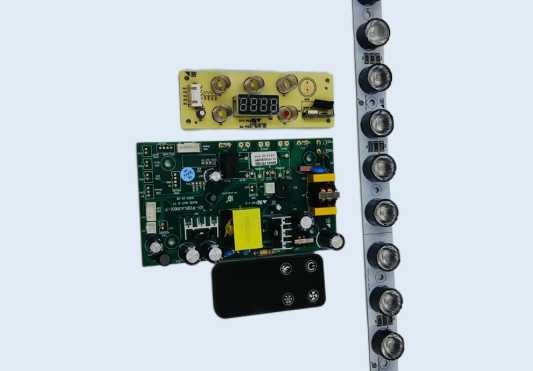
Technical Layout and Design Principles of the ESP32 Appliance Control PCBA
At the center of every smart domestic device sits a highly specialized printed circuit board assembly engineered to manage complex logic while handling substantial electrical currents. Utilizing an esp32 appliance control pcba enables hardware designers to consolidate multi-layered processing onto a single, space-optimized substrate. The primary challenge when layout engineering this type of assembly involves the strict segregation of electrical zones. High-power traces driving inductive loads, such as large compressor motors, heating elements, or water pumps, must be physically isolated from the low-voltage digital processing cores to prevent catastrophic system cross-talk.
Achieving this level of signal integrity requires a multi-layered approach to circuit design. Ground planes are strategically placed within the inner layers of the glass-reinforced epoxy substrate to act as electromagnetic shields. Additionally, decoupling capacitors and specialized filter networks are placed immediately adjacent to the main processing chip to suppress high-frequency noise generated by switching power supplies. By maintaining an uncorrupted pathway for low-voltage data signals, the control assembly ensures that delicate sensor readings regarding internal temperatures, fluid pressures, or motor velocity remain perfectly accurate throughout continuous operational cycles.
Centralized Machine Intelligence via the ESP32 IoT Control Board
The transition from a passive, mechanical machine to an autonomous, context-aware utility requires significant local processing power. Incorporating an esp32 iot control board provides modern household infrastructure with the computational capacity to execute edge-computing algorithms right at the device level. Traditional setups relied heavily on sending raw data to remote cloud servers to process operational changes, which often introduced problematic latency and vulnerabilities during network dropouts.
With a dual-core processor managing the internal system logic, the device can partition its operational workloads seamlessly. One core focuses exclusively on maintaining the state machine of the physical hardware, monitoring safety sensors, and executing real-time mechanical adjustments. The parallel processing core simultaneously manages the complex software stacks required for network communication, encryption protocols, and user interface rendering. This strict dual-core division ensures that regardless of network traffic or cloud delay, the primary safety functions of the appliance are never compromised, providing an instantaneous response to critical environmental changes.
Seamless Dual-Protocol Architecture in the ESP32 Wi-Fi Bluetooth Control Board
Modern domestic environments present a hostile landscape for wireless communications, characterized by structural barriers, reflective surfaces, and a high density of competing signals. Implementing an esp32 wi-fi bluetooth control board addresses these transmission challenges by combining wide-area network access with short-range localized connectivity onto a single piece of silicon. This dual-protocol capability ensures that the appliance can adapt its communication strategy depending on the proximity of the user and the volume of data being transferred.
The high-bandwidth Wi-Fi radio links the appliance directly to the local home router, establishing a permanent gateway to cloud-based ecosystem platforms. This connection allows the device to transmit diagnostic telemetry, download over-the-air firmware updates, and receive remote scheduling commands from a user who is miles away. Simultaneously, the onboard Bluetooth Low Energy radio facilitates rapid, local handshakes. When a user approaches the appliance with a smartphone, the Bluetooth protocol establishes a low-latency connection ideal for initial provisioning, local control, or direct field diagnostics, bypassing the home network entirely and reducing router congestion.
Enhancing Environmental Resilience Using the ESP32 Wireless Control Board for IoT Devices
Deploying sensitive digital electronics into high-power household devices exposes the hardware to intense physical and environmental stress that standard consumer electronics rarely experience. An esp32 wireless control board for iot devices must be explicitly engineered to survive years of constant mechanical vibration, rapid thermal cycling, and potential exposure to moisture or chemical detergents. Inside an automated washing system or a high-temperature cooking appliance, standard consumer-grade circuit boards would fail rapidly due to trace oxidation or micro-fractures in solder joints.
To counter these operational hazards, advanced manufacturing methodologies are applied during the physical fabrication process. The completed printed circuit assemblies are treated with a specialized conformal coating—a microscopic, protective polymer layer that seals all exposed components away from ambient humidity, kitchen grease, and airborne dust. Thermal vias are precision-drilled into the circuit board beneath heat-generating components to distribute excess thermal energy evenly across external heat sinks. Furthermore, surface-mount components are secured using high-tensile alloys capable of absorbing continuous physical vibrations without losing electrical continuity.
Proactive Lifecycle Optimization Driven by the IoT Appliance Control PCBA
The true value of modern connected hardware lies in its ability to transform how product maintenance and longevity are managed. Leveraging the structural headroom of an advanced iot appliance control pcba allows manufacturing brands to transition from a reactive service model to a proactive, predictive maintenance ecosystem. Instead of merely executing user commands, the control board continuously tracks the historical performance metrics of the attached peripheral components, measuring variations in current consumption, heat dissipation rates, and mechanical resistance.
Over time, localized data analysis can identify minor, subtle anomalies in these operating curves. For example, a minor increase in the electrical current required to spin a drum or pump a fluid indicates that a bearing or valve is beginning to wear down long before a visible or audible failure occurs. The control board can autonomously compile a diagnostic profile and transmit an early notification to both the consumer and the manufacturer. This early warning system allows for scheduled, preventive maintenance visits, preventing catastrophic machine breakdowns, extending the overall lifecycle of major household investments, and fostering a highly reliable, frictionless living experience.