
The quest for optimal sleep quality has led to a significant shift in how we manage bedroom climates. For decades, traditional electric blankets were the standard solution for cold winter nights. However, these older systems often introduced discomfort, such as localized hot spots, dry skin, and a general feeling of stuffiness caused by exposed heating wires running directly beneath the bedding. As consumers become more conscious of sleep hygiene and wellness, the industry has pivoted toward hydronic alternatives. These modern systems circulate heated water through soft, insulated tubes, offering a gentler and more uniform distribution of warmth.
At the core of this transition is the underlying electronic architecture that governs these appliances. Shifting from dry electric coils to a fluid-based thermal system introduces complex engineering variables. The system must not only heat the liquid but also monitor fluid levels, manage pump pressures, and ensure precise thermal regulation. Achieving this balance requires a highly specialized control unit capable of translating user inputs into smooth, reliable mechanical and thermal performance throughout the night.
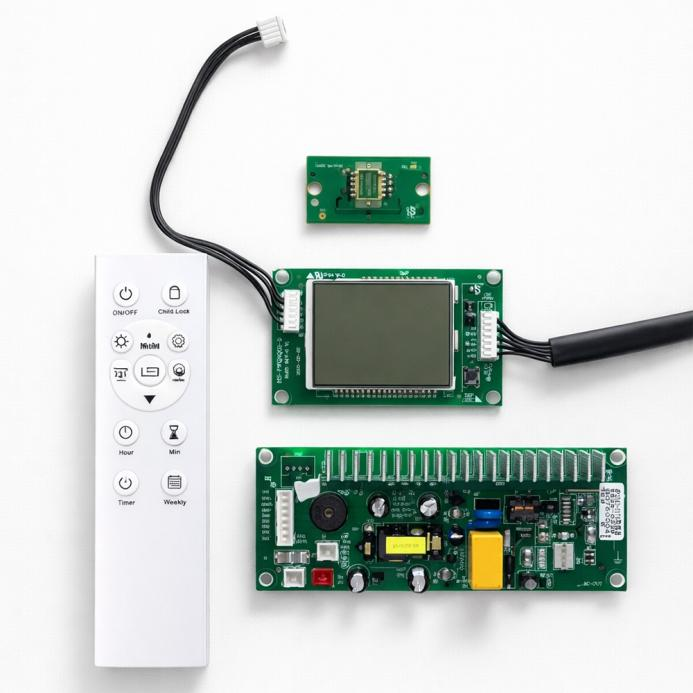
Designing Minimalist Interfaces with a Single-Color Display Water Heating Blanket PCBA
In modern product design, clarity and simplicity often trump complex, multi-colored interfaces, especially in products intended for use in a darkened bedroom. Integrating a single-color display water heating blanket pcba allows manufacturers to offer a user interface that is highly legible without being visually disruptive. A monochrome screen—such as a soft white or amber light-emitting diode readout—provides essential information like current temperature and operational status without casting an uncomfortable glow across the room.
From an engineering perspective, a monochrome display simplifies the data processing requirements of the main microcontroller. This efficiency reduces the overall power consumption of the control board and minimizes the risk of electronic noise interfering with sensitive temperature sensors. Furthermore, by focusing on a streamlined display architecture, developers can allocate more processing power to safety monitoring subroutines and precise fluid regulation algorithms, ensuring that the appliance runs smoothly and silently in the background while the user rests.
Tactical Ergonomics via the Knob Controlled Heated Blanket PCBA
While digital touchscreens dominate the modern appliance landscape, tactile interfaces remain superior for specific applications, particularly those operated half-awake in the dark. Implementing a knob controlled heated blanket pcba provides an intuitive, physical method for adjusting thermal settings. A rotary encoder or potentiometer allows users to instinctively find the control mechanism and adjust their sleep environment by feel alone, eliminating the need to look directly at a bright screen or navigate complex digital menus mid-sleep.
Integrating a physical knob into a digital control circuit requires robust hardware debouncing and precise signal interpretation. As the user turns the dial, the printed circuit board assembly must convert the mechanical rotation into discrete digital steps that correspond to micro-adjustments in thermal output. This setup requires durable component selection, as mechanical switches experience physical wear over thousands of rotations. High-quality encoders ensure that each click feels deliberate, giving the consumer tactile confirmation of their setting changes while maintaining a reliable connection to the master controller.
Algorithmic Efficiency within the Smart Temperature Control Water Heating Blanket PCBA
True comfort is rarely static, as human body temperature naturally fluctuates during the various stages of the sleep cycle. A smart temperature control water heating blanket pcba addresses this biological reality by moving away from fixed heat outputs toward dynamic thermal management. Instead of continuously pumping water at a single, unchanging temperature, an intelligent control system monitors both ambient room conditions and real-time fluid feedback to adjust its energy consumption.
The software embedded within these smart control units utilizes proportional-integral-derivative algorithms to predict thermal drift. If the bedroom temperature drops sharply in the early hours of the morning, the control board detects the change through external sensors and gradually increases the heating element’s duty cycle before the user can feel a chill. Conversely, as the user enters deep sleep and their metabolic heat output changes, the system gently scales back the warmth to prevent overheating and night sweats, fostering an environment that supports uninterrupted, restorative rest.
Fluidic Safety Protocols on the Water Heating Blanket Control Board
Operating a heating system that relies on water circulation requires strict safety boundaries to prevent electrical hazards and mechanical failures. The primary water heating blanket control board must act as a vigilant supervisor, constantly auditing the system’s structural integrity and operational boundaries. Because water conductively interfaces with heating elements, isolation and fault detection are paramount during the layout design phase of the circuitry.
A critical responsibility of this master circuit is the management of low-water levels and tilt detection. If a user accidentally knocks over the base heating unit or if the fluid reservoir depletes through natural evaporation, the control board must instantly register the change in pressure or continuity. Advanced boards utilize optical or capacitive level sensors that feed directly into hardware interrupts on the microcontroller. This ensures that the system cuts power to the heating elements within milliseconds of an anomaly, preventing dry-firing scenarios that could damage the appliance or pose a safety risk to the household.
Achieving Thermal Equilibrium with a Temperature-Controlled Heated Blanket PCBA
The ultimate goal of any hydronic bedding system is the maintenance of a perfectly stable microclimate. Achieving this requires a sophisticated temperature-controlled heated blanket pcba that can manage high-current loads while reading microvolt signals from thermal sensors. The board must bridge the gap between high-power components, like the water pump and heating coils, and delicate digital logic components.
To maintain an exact temperature without constant fluctuation, the circuit utilizes negative temperature coefficient thermistors placed at both the water inlet and outlet ports. These sensors send continuous voltage feedback to the processor. To prevent electrical noise from the water pump from distorting these readings, design engineers implement low-pass filters and isolated ground planes on the circuit board. This meticulous separation of power and signal paths ensures that the temperature readings remain incredibly accurate, allowing the system to maintain a steady, soothing warmth that honors the user’s precise preferences.