
The global shift toward comprehensive home automation has fundamentally altered the manufacturing standards of consumer appliances. Where simple electromechanical timers and isolated microcontrollers once sufficed, contemporary machinery demands continuous data exchange, ultra-low-latency processing, and secure cloud integration. This transformation is driven by a sophisticated layer of embedded electronics that operates beneath the chassis of modern household utilities. To meet the rigorous expectations of today’s market, engineering teams must move beyond generic hardware options. Instead, they are adopting dedicated, unified processing platforms that merge high-frequency radio communication directly with heavy-duty mechanical control systems.
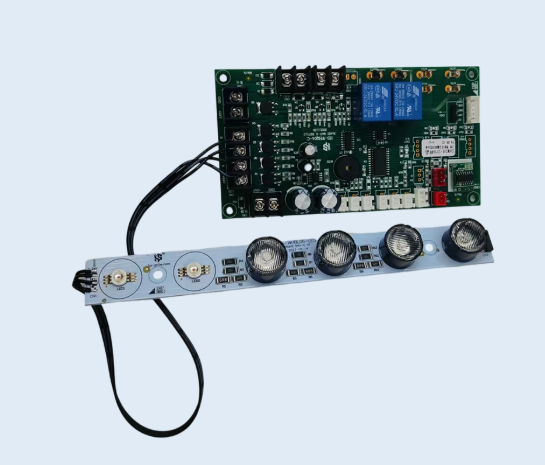
Technical Specifications and Layout Strategies of the ESP32 Control Board PCBA
At the foundational level of any automated appliance lies a meticulously engineered printed circuit board assembly. Implementing a specialized esp32 control board pcba provides industrial designers with a compact yet highly capable platform that serves as the central processing core. The layout strategy for such a board requires careful mapping of electronic traces to ensure that high-voltage power paths—such as those driving heating elements or induction compressors—remain strictly isolated from low-voltage digital signal pathways.
Achieving this balance involves utilizing multi-layered substrate architectures where dedicated ground planes act as shields against electromagnetic interference. When low-voltage logic lines run too close to alternating current lines, electrical noise can corrupt data packets, leading to erratic appliance behavior or unexpected system resets. By strategically separating these zones and placing decoupling capacitors in close proximity to the primary system-on-chip, the control board maintains pristine signal integrity even when operating under high electrical loads.
Maximizing Range and Energy Efficiency via the ESP32 Wi-Fi BLE 5.0 Control Board
Wireless performance in modern households is notoriously challenging due to structural barriers, competing frequencies, and the sheer density of connected equipment. Deploying an esp32 wi-fi ble 5.0 control board significantly mitigates these communication bottlenecks by taking advantage of the latest refinements in short-range and wide-area radio technologies. The inclusion of fifth-generation Bluetooth Low Energy introduces enhanced broadcasting capabilities and extended range options, allowing appliances to maintain a stable local connection across greater distances without consuming excessive power.
During standard operation, the dual-radio framework divides tasks based on urgency and data volume. The high-bandwidth Wi-Fi protocol handles massive data transfers, such as downloading over-the-air firmware upgrades or streaming complex diagnostics to manufacturer cloud servers. Meanwhile, the power-optimized Bluetooth protocol continuously listens for localized proximity cues, allowing a user’s mobile device to instantly wake the appliance or adjust settings without demanding a handshake from the main home router. This dual-layered communication structure ensures that the device remains highly responsive while preserving its overall energy efficiency profile.
Overcoming Environmental Demands with the Dedicated ESP32 Appliance Control PCBA
Household appliances subject internal electronics to some of the most punishing environments imaginable. Whether it is the humid, chemical-laden environment of an automated dishwasher or the intense localized heat of a smart convection oven, a standard circuit board would fail rapidly due to thermal stress and atmospheric corrosion. Consequently, an esp32 appliance control pcba must undergo rigorous ruggedization processes during the manufacturing and assembly phases.
Industrial-grade components capable of withstanding wider temperature variations are selected to replace standard consumer silicon. Furthermore, the entire completed assembly is shielded using specialized conformal coatings that form an impenetrable barrier against moisture, grease, and airborne dust particles. To address the physical vibrations generated by heavy electric motors and pumps, structural reinforcement points and robust surface-mount soldering techniques are employed, ensuring that mechanical fatigue does not lead to fractured joints or intermittent component contact over a decade of continuous service.
Streamlining System Architecture Using a Unified ESP32 IoT PCBA
Traditional smart appliance designs often relied on a fragmented multi-chip approach, combining an older microcontroller for physical machine logic with a separate, secondary module tacked on to handle wireless networking. Transitioning to a unified esp32 iot pcba eliminates this unnecessary architectural complexity by combining processing and connectivity into a single piece of silicon. This consolidation reduces the physical bill of materials for manufacturers and drastically simplifies the internal software stack.
With a single processing core managing both the physical inputs and the cloud communication layers, data synchronization issues are virtually eliminated. The dual-core processor inside the module allows software engineers to partition tasks cleanly; one core can run deterministic, real-time control loops that monitor safety sensors, fluid levels, and emergency cutoff switches, while the parallel core manages network security, encryption protocols, and user interface rendering. This strict separation ensures that a sudden spike in network traffic or a slow cloud server handshake will never delay a critical safety shutdown sequence.
Driving Predictive Maintenance through the Advanced IoT Appliance Control PCBA
The ultimate value of integrating cutting-edge hardware into domestic machinery lies in the shift from reactive operation to proactive, intelligent automation. Leveraging the computational headroom of an advanced iot appliance control pcba enables edge-computing methodologies that analyze appliance health in real time. Instead of functioning as a passive receiver of commands, the control board monitors the subtle electrical signatures of attached components, tracking how much current a motor draws or how rapidly a heating element reaches its target temperature.
Over time, localized algorithms can identify minor irregularities in these performance metrics, recognizing that a slight increase in motor friction indicates a bearing is approaching failure long before the consumer notices a problem. The board can then autonomously log a diagnostic report and alert the user via a smartphone application, allowing for scheduled maintenance before a total breakdown occurs. This level of self-awareness fundamentally elevates the user experience, transforming ordinary household utilities into highly reliable, self-preserving components of the modern smart ecosystem.