
The landscape of personal wellness technology has shifted dramatically over the last decade, moving from simple mechanical devices to sophisticated, sensor-driven ecosystems. At the heart of this transformation lies the mist heater control PCBA, a specialized component that serves as the “brain” for high-end humidification systems. These printed circuit board assemblies are no longer just about toggling power; they are about precision, safety, and the delicate balance of thermodynamics. As consumers demand more from their indoor environments—seeking not just moisture, but sterilized, temperature-controlled vapor—the engineering behind these boards has become increasingly complex.
For manufacturers in the health appliance sector, the quest for the perfect indoor climate begins with heat. Unlike traditional cool-mist systems that simply aerosolize water at room temperature, modern appliances often integrate heating elements to kill bacteria or improve moisture absorption in the air. This requires a robust humidifying heater control board capable of managing high-current loads while simultaneously processing delicate signals from humidity sensors. The integration of these two worlds—high-power thermal management and low-power digital logic—is where the true innovation occurs.
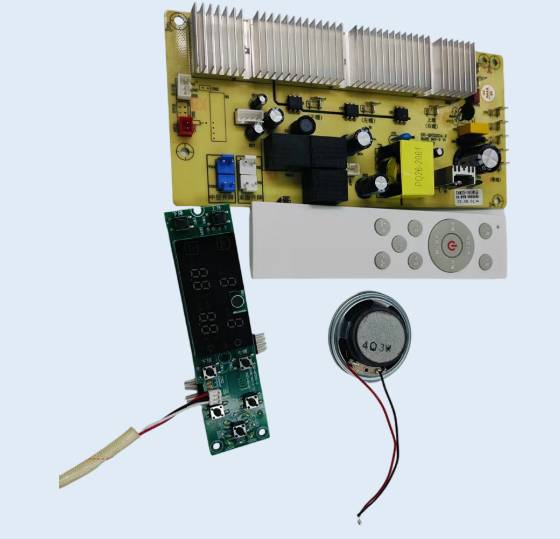
Technical Sophistication Of The Ultrasonic Mist Heater Control Board
The marriage of ultrasonic vibration and thermal regulation represents a peak in humidification engineering. An ultrasonic mist heater control board must orchestrate several distinct physical processes at once. First, it manages the piezoelectric transducer, which vibrates at high frequencies (usually around 1.7 MHz) to create a fine fog. Second, it must regulate a heating element that pre-warms the water or the mist itself.
Achieving this requires sophisticated pulse-width modulation (PWM) strategies. If the water is too cold, the ultrasonic efficiency drops; if it is too hot, the life of the transducer is compromised. A well-designed control board uses a feedback loop to maintain an optimal temperature window. This ensures that the mist is fine enough to stay suspended in the air while being warm enough to provide the therapeutic benefits associated with warm-mist therapy, such as improved sinus relief and reduced airborne pathogens.
Moreover, these boards must be designed with extreme durability in mind. Because they operate in high-humidity environments, specialized conformal coatings are often applied to the ultrasonic mist heater control board to prevent corrosion and short circuits. This layer of protection is vital for health appliances that are expected to run continuously for months at a time, often in bedrooms or nurseries where reliability is non-negotiable.
Safety Paradigms In Warm Mist Humidifier Heater PCBA Design
When dealing with heating elements submerged in or near water, safety is the paramount concern for any warm mist humidifier heater PCBA. Engineering a board for this application involves multiple layers of redundancy. Thermal runaway is the primary threat; if a sensor fails and the heater stays on without water, the device could melt or catch fire. Therefore, advanced boards incorporate independent hardware-level shutoffs that bypass the microprocessor entirely if a certain temperature threshold is reached.
Dry-burn protection is another critical feature. The warm mist humidifier heater PCBA utilizes various sensing technologies—such as capacitive liquid level sensors or optical probes—to detect when water levels are low. The logic on the board is programmed to gracefully shut down the heating element before the reservoir is empty, preventing stress on the components. This level of “intelligence” is what separates a cheap consumer product from a professional-grade health appliance.
Furthermore, electromagnetic interference (EMI) must be strictly controlled. Because these boards are often used in homes filled with other wireless devices, the switching power supplies on the PCBA must be filtered to prevent “noise” from affecting Wi-Fi signals or other sensitive electronics. This requires a deep understanding of circuit layout and the strategic placement of decoupling capacitors and inductors.
Optimization Through A Custom Electric Heater PCBA Manufacturer
The “off-the-shelf” approach rarely works for premium health appliances. Every device has a unique form factor, airflow pattern, and target humidity output. This is why brands increasingly turn to a custom electric heater PCBA manufacturer to develop bespoke solutions. Customization allows for the integration of modern user interfaces, such as capacitive touch panels, LED displays, or even Bluetooth and Wi-Fi modules for smartphone connectivity.
A specialized manufacturer understands the nuances of thermal dissipation within the PCBA itself. When a board controls a high-wattage heater, the traces on the PCB must be wide enough to carry the current without overheating the board’s own substrate. A custom electric heater PCBA manufacturer uses advanced simulation software to model heat distribution across the board, ensuring that sensitive microcontrollers are placed far away from heat-generating MOSFETs or relays.
This collaborative design process also addresses the specific regulatory requirements of different global markets. Whether it is meeting UL standards in North America or CE requirements in Europe, a custom manufacturer ensures that the board’s architecture includes the necessary creepage and clearance distances, as well as fuse protection, to pass rigorous safety certifications. This level of expertise reduces time-to-market and minimizes the risk of costly product recalls.
Future Trends In Humidifying Heater Control Board Technology
Looking toward the future, the humidifying heater control board is becoming even more integrated with “Smart Home” ecosystems. We are seeing a shift toward Artificial Intelligence of Things (AIoT), where the board doesn’t just react to a set point but learns the user’s habits. For instance, if a user prefers a warmer mist during winter mornings, the board can begin pre-heating the water before the user even wakes up, based on historical data and local weather forecasts.
Energy efficiency is another area of rapid development. Older heater designs were often binary—either fully on or fully off. Newer humidifying heater control board designs utilize variable power control, allowing the heater to sip power just enough to maintain a constant temperature. This reduces the “cycling” effect, which can be noisy and hard on the components, while also lowering the electricity bill for the end-user.
Sustainability is also influencing the materials used in PCBA production. From lead-free soldering to the use of halogen-free laminates, the internal components of health appliances are becoming as “healthy” as the air they produce. As consumers become more conscious of the environmental impact of their electronics, the demand for eco-friendly manufacturing processes provided by a custom electric heater PCBA manufacturer will only continue to grow.
In conclusion, the specialized world of mist heater control is a fascinating intersection of fluid dynamics, thermal management, and digital logic. As we continue to prioritize our indoor air quality and personal health, the invisible PCBA hidden inside our humidifiers will remain the silent hero, ensuring that every breath we take is clean, warm, and perfectly balanced. The journey from a simple heating coil to a sophisticated mist heater control PCBA reflects our broader technological journey toward creating environments that truly nurture human well-being.