
The landscape of modern living is undergoing a profound paradigm shift driven by the rapid maturity of the internet of things. Today, the consumer public no longer views connected appliances as novel luxuries but rather as baseline standards for efficiency, convenience, and home management. Behind the sleek interfaces and elegant industrial designs of contemporary laundry systems, kitchen tools, and climate units lies a complex layer of embedded intelligence. At the heart of this revolution is a fundamental transition away from simplistic, isolated microcontrollers toward highly integrated, multi-protocol processing cores capable of simultaneous computing and global wireless communication. For manufacturing brands looking to capture market share, the development of these advanced internal control architectures has become the primary battleground for product differentiation and long-term reliability.
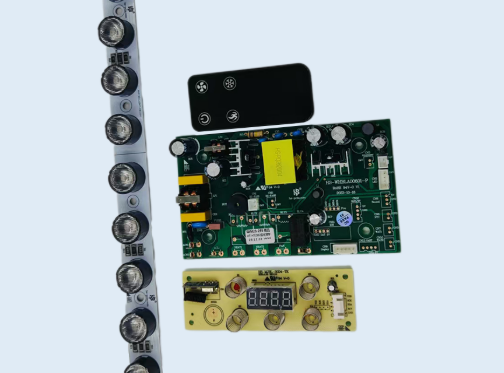
The Strategic Manufacturing Advantages of the OEM ESP32 Control Board PCBA
Navigating the transition from traditional manufacturing to the production of high-tech hardware presents considerable logistical and engineering hurdles. Utilizing an oem esp32 control board pcba allows major appliance brands to integrate field-tested, certified wireless technology directly into their product lifecycles without incurring the massive research and development expenses associated with ground-up silicon engineering. This industrial approach provides a standardized, deeply reliable computational foundation that can be customized at the circuit layout level to fit the exact spatial and electrical requirements of a specific product line.
By relying on an original equipment manufacturing model, corporations can ensure a highly optimized bill of materials while maintaining absolute control over the physical build quality. The specialized printed circuit board assembly consolidates multiple discrete components—such as memory modules, power management units, and radio-frequency chips—onto a single, multi-layered substrate. This level of hardware consolidation not only reduces the physical space required inside the appliance chassis but also significantly lowers the probability of assembly errors, trace failures, and signal degradation across the entire production run.
Deep Architectural Customization Through an ESP32 Control Board OEM Partnership
Every class of household equipment introduces its own unique set of operational parameters, spatial constraints, and power requirements. Engaging with an esp32 control board oem provider gives engineering teams the flexibility to manipulate the underlying hardware blueprint to serve specific mechanical configurations. Whether an appliance requires high-current relay traces to drive massive inductive motor loads or a multitude of analog-to-digital converter channels to monitor subtle environmental sensors, the physical circuit assembly can be tailored to establish the perfect hardware environment.
Furthermore, a dedicated manufacturing partnership ensures that the physical board layout minimizes electromagnetic interference. Modern connected homes are saturated with competing wireless frequencies, and the internal components of an appliance—such as variable-speed compressors or high-frequency switching power supplies—can generate substantial localized electrical noise. A customized engineering approach routes sensitive low-voltage digital signal traces away from high-voltage AC lines, utilizing internal ground planes within the glass-reinforced epoxy laminate to act as an impenetrable shield. This prevents data corruption and ensures flawless internal communication between the core processor and external sensor loops.
Overcoming Punishing Domestic Environments with a Ruggedized ESP32 Appliance Control Board
The operational environment within a household appliance is remarkably hostile to delicate digital electronics. Unlike a standard consumer smartphone or router that sits in a stable, climate-controlled space, an esp32 appliance control board must survive decades of continuous exposure to extreme thermal fluctuations, structural vibrations, high humidity, and airborne contaminants. Inside an automated washing machine, a smart cooking range, or an outdoor climate control system, standard circuit boards would rapidly succumb to trace oxidation, component warping, or solder joint fractures.
To achieve industrial-grade longevity, advanced fabrication and stabilization techniques must be applied during the assembly phase. The completed circuit units are treated with specialized conformal coatings—a microscopic polymer layer that wraps around every capacitor, resistor, and silicon die to seal them away from moisture and grease. To handle the constant mechanical shaking generated by high-speed spin cycles or internal pumps, surface-mount components are secured using high-tensile solder alloys, and critical junctions are reinforced with structural adhesives. Thermal vias are also strategically drilled beneath power-management components to dissipate excess heat evenly into external heat sinks, keeping the core processing units running well within safe thermal limits.
Balancing Range and Connectivity with the ESP32 Wi-Fi Bluetooth Control Board
Establishing a permanent, unshakeable link between a home utility and the broader digital world requires a sophisticated, flexible wireless strategy. Deploying an esp32 wi-fi bluetooth control board solves this dilemma by offering a native dual-radio architecture that handles both wide-area network communications and low-latency local interactions concurrently. This eliminates the need for expensive secondary wireless modules, simplifying the embedded software stack and minimizing overall power draw.
The high-bandwidth Wi-Fi radio links the appliance directly to the local residential router, establishing an uninterrupted pipeline to cloud-based monitoring networks and consumer application ecosystems. This connection allows the device to transmit continuous performance telemetry, download over-the-air firmware patches, and adapt to remote user inputs from across the globe. Simultaneously, the onboard Bluetooth Low Energy radio operates as a localized interaction channel. When a user approaches the machine with a mobile device, the Bluetooth protocol enables instant pairing for initial setup, localized adjustments, or direct field diagnostics, bypassing the home router entirely and ensuring total operational control even during local internet outages.
Decentralized Edge Computing Frameworks via the Integrated ESP32 IoT PCBA
The true metric of a genuinely intelligent appliance lies in its capacity for autonomous decision-making. Incorporating an esp32 iot pcba provides the computational headroom necessary to shift away from traditional, rigid programming logic toward adaptive, edge-computing frameworks. Rather than operating as a passive terminal that must constantly transmit data to a remote cloud server to determine its next action, the embedded hardware processes complex environmental and usage patterns right at the machine level.
The internal dual-core architecture allows software developers to isolate tasks cleanly to maximize both performance and system safety. One processing core runs real-time, deterministic control loops that continuously monitor critical security sensors, internal fluid pressures, and temperature thresholds. The parallel processing core works independently to manage data encryption, cloud handshakes, and user interface rendering. This strict separation ensures that even if the local network experiences severe latency or a sudden disconnect during data transmission, the primary safety and operational loops continue to execute flawlessly in milliseconds, completely immune to external network disruptions.