
The landscape of modern home automation and industrial connectivity has been fundamentally reshaped by the emergence of highly integrated, low-power microcontrollers. At the forefront of this technological shift is the ESP32 Wi-Fi Bluetooth control board, a versatile hardware platform that has become the de facto standard for developers and manufacturers alike. As the consumer demand for “smart” functionality moves from a luxury addition to a standard expectation, the role of robust, dual-communication control boards becomes critical. The ESP32 offers a unique combination of high-speed Wi-Fi and energy-efficient Bluetooth Low Energy (BLE), making it the ideal candidate for managing the complex logic required in contemporary household and industrial machinery.
Engineering a smart appliance control board with esp32 involves more than just selecting a powerful chip; it requires a deep understanding of how to bridge the gap between digital intelligence and mechanical execution. These boards act as the central nervous system of an appliance, translating wireless commands from a smartphone or cloud server into physical actions, such as modulating a motor or regulating a heating element. By integrating the ESP32 directly into the Printed Circuit Board Assembly (PCBA), engineers can significantly reduce the physical footprint of the electronics while enhancing the overall reliability and responsiveness of the device.
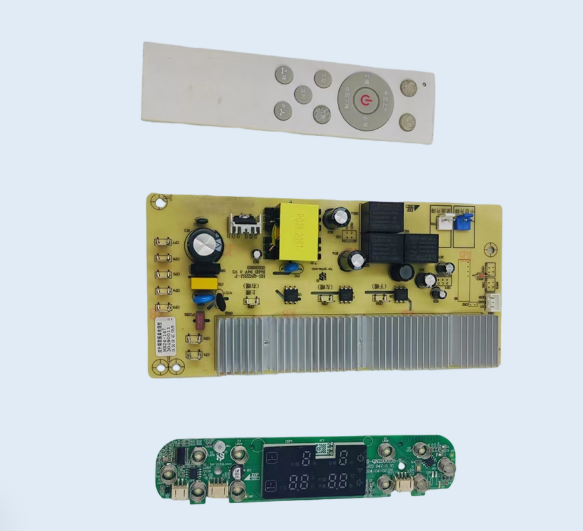
Technical Advantages Of The ESP32 Wi-Fi Bluetooth Control Board
The primary reason for the widespread adoption of the esp32 wi-fi bluetooth control board in the appliance sector is its dual-core architecture and its rich array of peripheral interfaces. Unlike simpler microcontrollers, the ESP32 can handle complex networking tasks on one core while managing real-time sensor data and motor control on the other. This prevents the “latency” that often plagues lower-end smart devices, ensuring that an appliance responds instantly to user inputs. Furthermore, the built-in hall sensors, capacitive touch interfaces, and high-speed SPI/I2C ports allow a single esp32 appliance control board to manage everything from a touch-sensitive front panel to internal environmental sensors without the need for additional, costly co-processors.
In the context of the Internet of Things, power management is a crucial factor. The esp32 iot pcba is designed with multiple power modes, allowing it to “sleep” during periods of inactivity and wake up instantly when a Wi-Fi packet is received or a sensor threshold is triggered. This is particularly important for battery-operated smart devices or appliances that must comply with strict standby-power regulations. By optimizing the power consumption of the esp32 wi-fi bluetooth control board, manufacturers can create eco-friendly products that maintain a constant cloud connection without inflating the user’s energy bill.
Security Protocols Within The Smart Appliance Control Board With ESP32
As appliances become more connected, they also become potential targets for cyber-attacks. Therefore, a modern smart appliance control board with esp32 must prioritize hardware-level security. The ESP32 chip includes integrated flash encryption and secure boot features, which ensure that only authorized firmware can run on the device. This prevents malicious actors from “re-flashing” the appliance to gain access to the home network. When designing an iot appliance control pcba, engineers implement these security layers to protect sensitive user data and ensure that the appliance cannot be remotely manipulated in a way that causes physical damage or safety hazards.
Moreover, the dual Wi-Fi and Bluetooth capability allows for a more secure “onboarding” process. When a user first sets up their appliance, the esp32 appliance control board can use a secure Bluetooth handshake to transfer Wi-Fi credentials from a mobile app. This method is far more secure and user-friendly than traditional “Access Point” modes, which often leave the device’s network open and vulnerable during the configuration phase. By leveraging these native hardware features, the esp32 iot pcba provides a foundation of trust that is essential for the long-term adoption of smart home ecosystems.
Scalability And Flexibility Of The ESP32 Appliance Control Board
One of the most significant challenges in appliance manufacturing is the need for product variety. A manufacturer might produce a range of products from basic ovens to high-end refrigerators, each requiring different levels of control logic. The esp32 appliance control board excels in this environment due to its immense scalability. The same underlying esp32 wi-fi bluetooth control board design can be adapted for a wide variety of applications simply by changing the peripheral sensors and modifying the firmware. This standardization allows manufacturers to consolidate their supply chains and reduce the time-to-market for new product iterations.
Furthermore, the vast open-source community and the robust support for various real-time operating systems (RTOS) mean that software development for the smart appliance control board with esp32 is highly efficient. Developers can utilize a massive library of pre-verified code for networking, display management, and sensor fusion. This reduces the risk of software bugs and allows for “Over-The-Air” (OTA) updates, ensuring that the iot appliance control pcba can receive feature enhancements or security patches long after the product has left the factory floor. This capability effectively future-proofs the appliance, providing a better long-term value proposition for the consumer.
Industrial Integration And The ESP32 IoT PCBA Solution
Beyond the kitchen and the laundry room, the esp32 iot pcba is making significant inroads into industrial automation and building management. In these environments, the boards are often subjected to electrical noise, vibration, and temperature fluctuations. A professionally manufactured iot appliance control pcba for industrial use is built with high-quality components and specialized shielding to maintain signal integrity. The ESP32’s ability to interface with long-range industrial sensors while maintaining a high-bandwidth Wi-Fi link for data backhaul makes it an invaluable tool for “Industry 4.0” initiatives.
In a large-scale facility, hundreds of these esp32 wi-fi bluetooth control board units can be networked together to provide a comprehensive view of the operational status. Whether it is monitoring the temperature of a massive cooling system or controlling the lighting across an entire warehouse, the esp32 appliance control board provides a cost-effective and reliable solution. The ability to use BLE for localized “mesh” networking between devices, combined with Wi-Fi for centralized cloud reporting, allows for a flexible network topology that can adapt to the physical constraints of any industrial environment.